
Cigarette Tax Stamp Technical Specifications Introduction
Cigarette tax stamp technical specifications define the physical format, materials, printing methods, security features, variable data, application requirements, quality controls, and delivery conditions for a tax stamp project.
For government authorities, authorized contractors, security printers, and tobacco-industry procurement teams, clear specifications help suppliers evaluate production feasibility, prepare comparable quotations, and reduce technical risks during tender execution.
Requirements vary by jurisdiction, so the final design must follow the applicable excise program, tender documents, packaging line, and authentication system rather than a single universal specification.
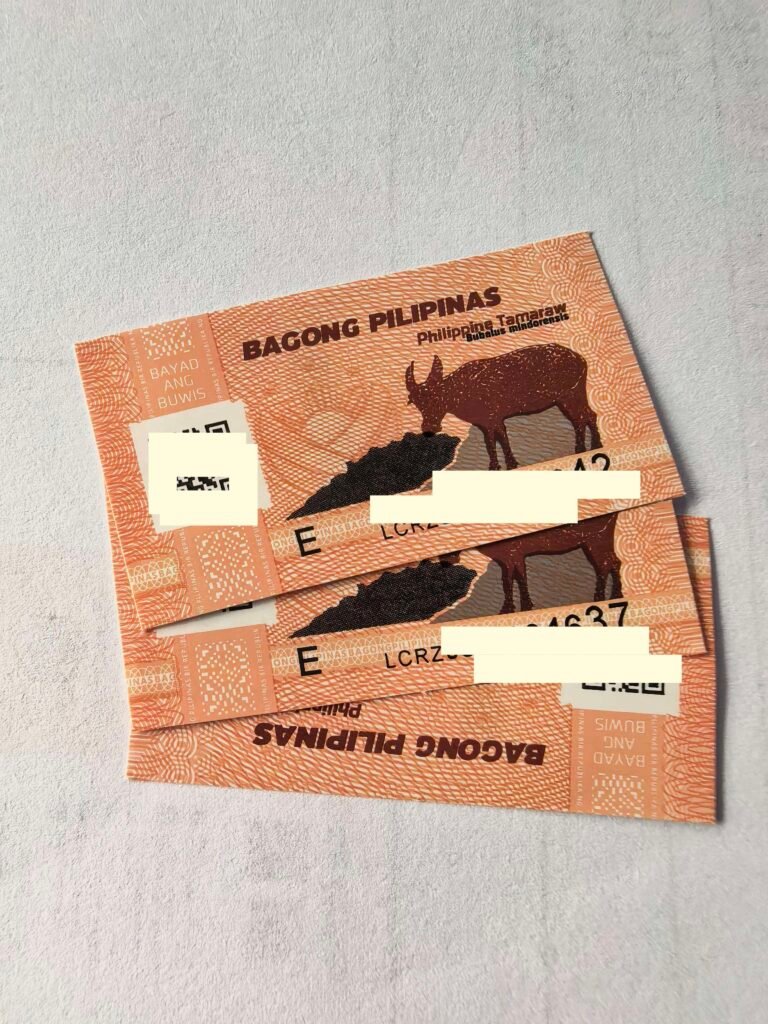
What Do Cigarette Tax Stamp Technical Specifications Include?
Cigarette tax stamp technical specifications translate a tax authority’s security, authentication, application, and delivery requirements into measurable production criteria. They normally cover the stamp format, dimensions, substrate, artwork responsibility, security features, serialization, sample requirements, quality control, supplier qualifications, packaging, and delivery schedule.
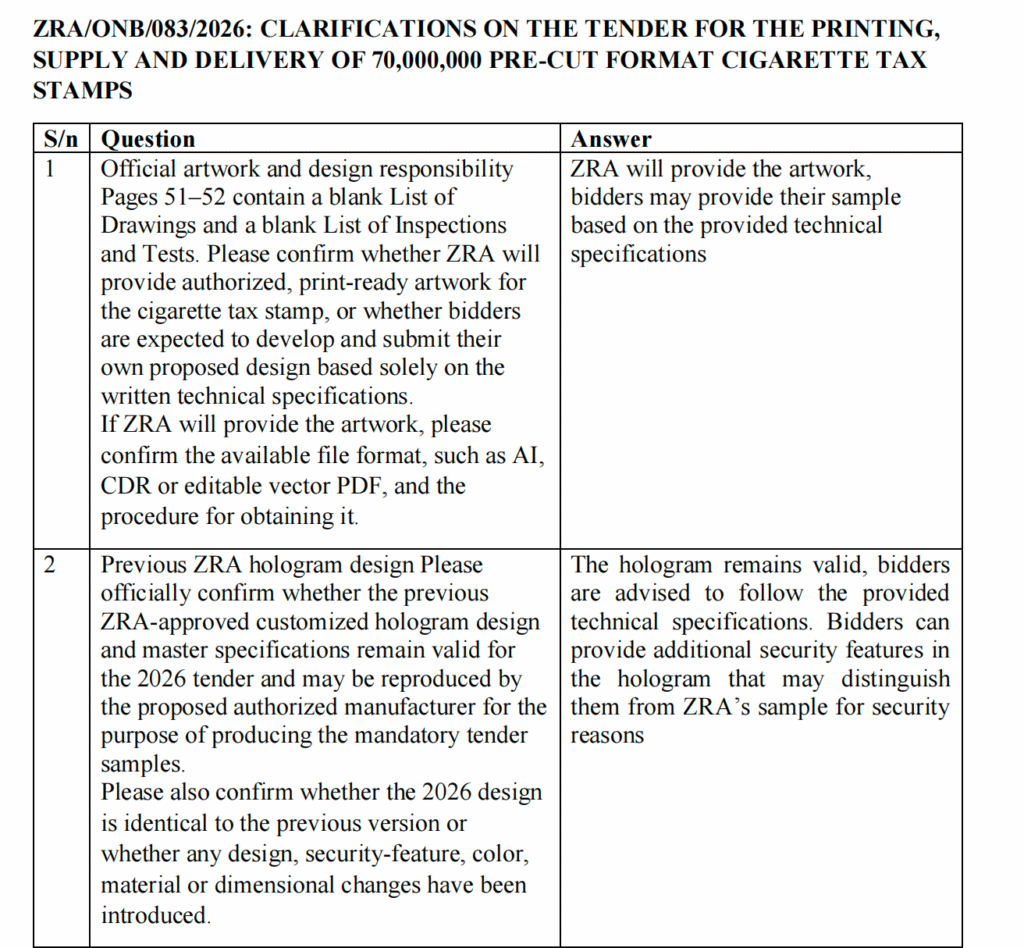
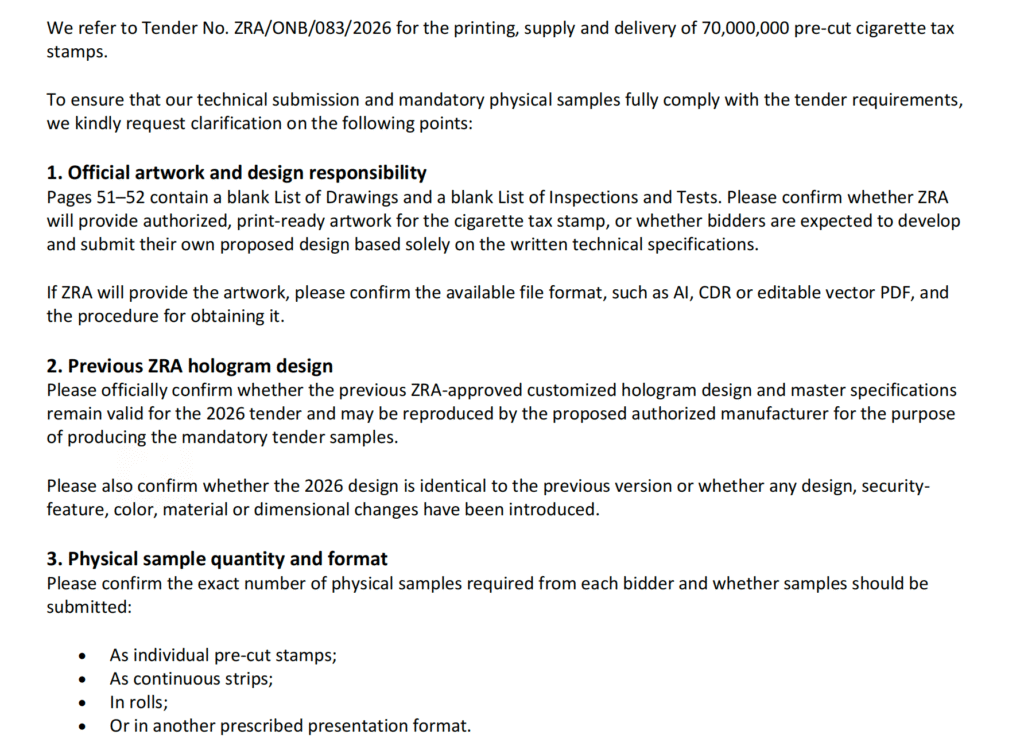
A 2026 Zambia Revenue Authority tender for 70,000,000 pre-cut cigarette tax stamps provides a practical example. The specification defined the stamp size, paper weight, holographic and printed security features, serial-number structure, sample format, packing method, and supplier documentation. Subsequent clarification was still required to determine who would provide the authorized artwork and serial numbers, how samples would be evaluated, and which party had to hold the required certifications.
This illustrates an important procurement principle: a quantity and security-feature list alone is not a complete specification. Buyers should also define data ownership, artwork authorization, sample presentation, acceptance criteria, manufacturer responsibility, and delivery conditions before production begins.
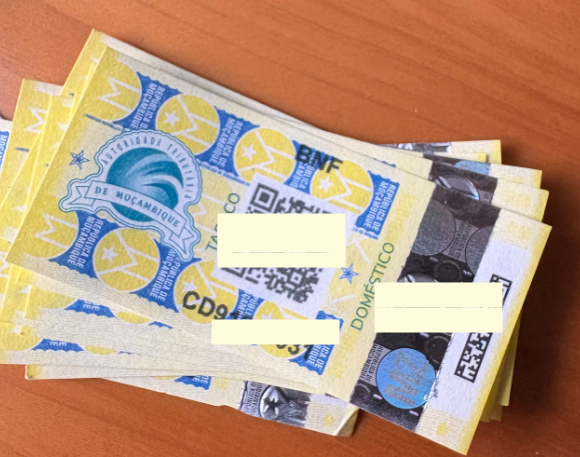
| Specification Area | Example from a 2026 Zambia Tender | Information Buyers Should Confirm |
|---|---|---|
| Project Quantity | Printing, supply, and delivery of 70,000,000 cigarette tax stamps | Total quantity, delivery lots, reserve quantity, and permitted production variance |
| Stamp Format | Individual pre-cut stamps packed in boxes | Whether tender samples and commercial deliveries use the same format |
| Dimensions | 44.45 ± 0.25 mm × 19.05 ± 0.5 mm per stamp | Finished dimensions, tolerance, shape, cutting accuracy, and application position |
| Substrate | 70 GSM short-grain UV-fibre paper | Approved paper source, fibre characteristics, grain direction, moisture conditions, and available material evidence |
| Artwork | The authority confirmed that it would provide the official artwork; bidders could prepare samples from the written specifications | Authorized file format, release procedure, color references, revision control, and permitted sample artwork |
| Printed Design | Authority logo, manufacturer’s prefix, eight-digit alphanumeric serial number, top foil strip, and authority-defined screen pattern | Authorized logos, text, colors, prefix allocation, numbering layout, and artwork approval responsibility |
| Security Features | Customized hologram, hidden feature, variable microprinting, guilloche design, multiplex patterns, invisible fluorescent printing, copy/scanning VOID features, ESP, REMIC, and UV features | Exact location, size, verification method, acceptance criteria, and whether each feature must appear in the tender sample |
| Serialization | Manufacturer’s prefix and eight-digit alphanumeric serial numbering; the authority confirmed that it would provide the serial numbers | Number range, data format, duplicate prevention, rejected-number control, specimen numbering, and final data reconciliation |
| Tender Samples | Samples were required as individual pre-cut stamps, with the listed security features physically demonstrated | Exact sample quantity, submission deadline, specimen marking, packaging, labeling, and whether destructive testing is permitted |
| Quality Evaluation | Bidders were required to provide item-by-item commentary against the technical requirements | Inspection method, dimensional tolerance, UV and hologram verification, numbering checks, sampling plan, and rejection criteria |
| Packaging | Pre-cut stamps packed in boxes; samples had to be securely packed and labeled with the tender reference and bidder information | Quantity per box, internal protection, batch identification, carton markings, and secure transport requirements |
| Lead-In and Lead-Out | Maximum lead-in and lead-out lengths of one metre were stated in the specification | Whether this applies to production conversion, inspection material, sample strips, or another manufacturing stage |
| Supplier Documentation | Manufacturer’s Authorisation and specified quality or security-printing credentials were required | Which documents must be held by the manufacturer, local bidder, joint-venture member, or either party |
| Delivery | Bulk supply and physical sample delivery formed part of the tender requirements | Production schedule, phased delivery, destination, inspection period, shipping method, and required delivery records |
The required fields will vary by authority and jurisdiction. Buyers should therefore treat this as a procurement example rather than a universal cigarette tax stamp specification. Final production must follow the approved tender document, official artwork, authorized serial-number data, applicable regulations, and the buyer’s written acceptance criteria.
Stamp Dimensions, Shape and Pack Application
Stamp dimensions must be defined as measurable production requirements rather than estimated from photographs or previous samples. In the 2026 Zambia cigarette tax stamp tender, each pre-cut stamp was specified at 44.45 ± 0.25 mm × 19.05 ± 0.5 mm. These tolerances establish the acceptable finished width and length, but buyers should also define corner shape, cutting quality, print-to-cut registration, and the permitted position of security elements near the edges.
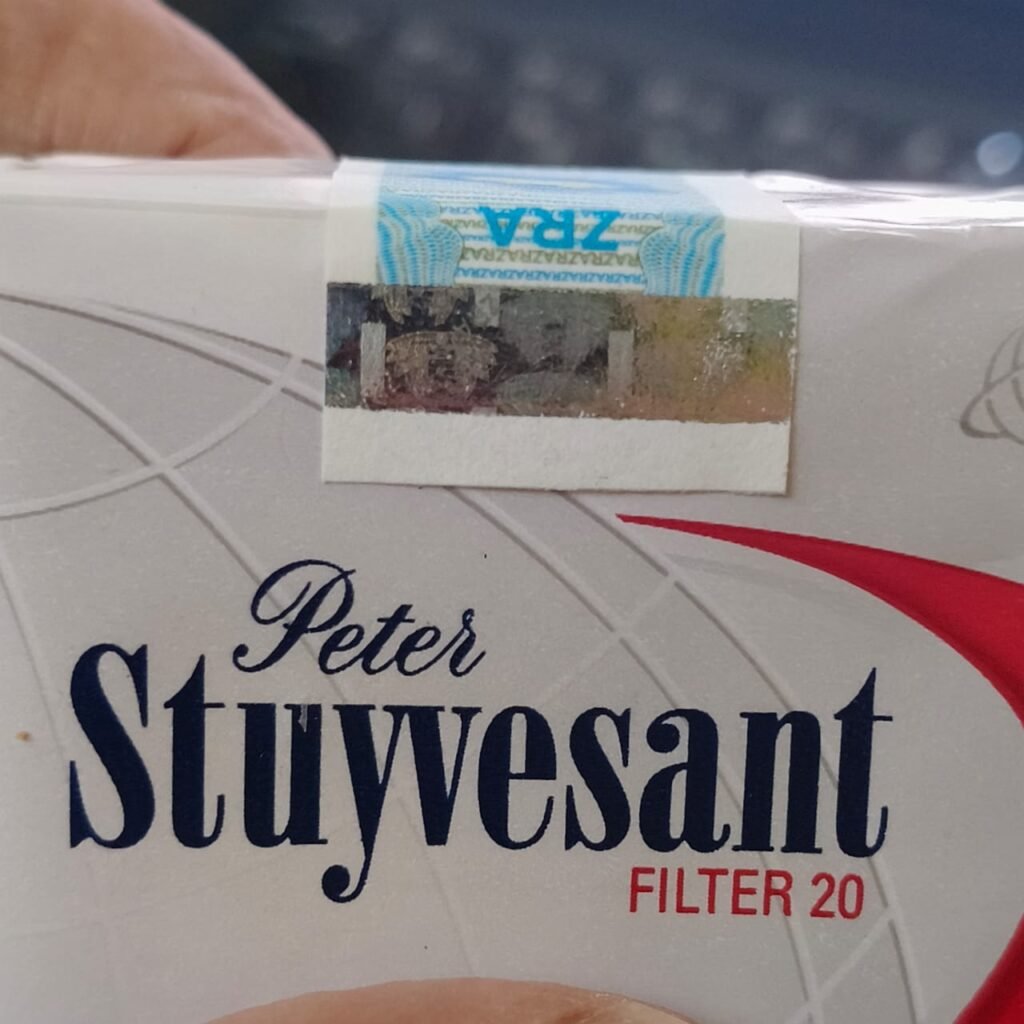
Complete cigarette pack tax stamp specifications should identify where the stamp will be applied: across the top opening, over a side flap, or in another position designed for inspection and pack opening. The location affects the required stamp shape, adhesive area, grain direction, and whether the stamp should tear or show visible interference when the cigarette pack is opened.
The Zambia specification required individual pre-cut stamps packed in boxes, but pack material, application position, and application method still need to be confirmed before production. A stamp applied manually may have different handling and backing requirements from one used on an automated packaging line.
Buyers should therefore provide the cigarette pack dimensions, hard-pack or soft-pack structure, surface material, opening direction, application method, production-line orientation, operating speed, and inspection-camera position. Physical samples should then be tested on the actual packs before final artwork and mass production are approved.
Substrate, Adhesive and Tamper-Evident Construction
Substrate and adhesive requirements should be selected according to the cigarette pack surface, application method, security design, and storage environment. Depending on the project, tax stamps may use security paper, self-adhesive paper, film, composite materials, holographic foil, destructible constructions, permanent adhesives, security die-cuts, or non-adhesive dry-stamp formats. No single structure is suitable for every tobacco program.
In the 2026 Zambia cigarette tax stamp tender, the specified substrate was 70 GSM short-grain UV-fibre paper, and the stamps had to be supplied in individual pre-cut form. The required tobacco tax stamp security features included a customized hologram strip, invisible fluorescent printing, copy-and-scanning VOID effects, microprinting, guilloche patterns, and other visible and hidden elements. However, the published requirements did not fully define the adhesive chemistry, cigarette-pack surface, application pressure, or environmental testing conditions. These points should therefore be confirmed before sample production.
Complete cigarette tax stamp technical specifications should state whether the stamp is self-adhesive, heat-applied, dry-applied, or attached by another method. Adhesive performance can vary on coated paperboard, plastic film, foil-laminated packs, and other surfaces. Temperature, humidity, storage time, application pressure, and production-line speed may also affect bonding.
A pre-cut format may require different handling from reel format cigarette duty stamps, particularly for liner design, feeding, positioning, and automated application. In either case, “tamper-evident” means that opening or removal leaves identifiable evidence; it does not mean the pack is physically impossible to open.
For reliable tobacco excise stamp procurement, samples should be tested on the actual cigarette packs using the intended application process, storage conditions, and opening method before mass production is approved.
Overt, Semi-Covert and Covert Security Features
Effective tobacco tax stamp security features normally combine more than one level of authentication. Overt features support rapid visual inspection, semi-covert features require simple tools or trained personnel, and covert features are reserved for authorized inspection or forensic verification. The classification of a feature may vary according to the technology and verification method, so it should be clearly defined in the cigarette tax stamp technical specifications.
In the 2026 Zambia cigarette tax stamp tender, the mandatory features included a customized hologram strip, hidden features, variable microprinting, guilloche designs, multiplex patterns, invisible fluorescent printing, copy-and-scanning VOID effects, ESP, REMIC, UV features, and alphanumeric serial numbering. For procurement planning, these requirements may be grouped as follows:
| Security Level | Examples from the Tender | Primary Verification Method |
|---|---|---|
| Overt | Customized hologram strip, guilloche designs, multiplex patterns and visible serial numbers | Direct visual inspection |
| Semi-Covert | Variable microprinting, ESP, REMIC, UV response, invisible fluorescent printing and copy/scanning VOID effects | Magnifier, UV lamp, scanner or trained inspection |
| Covert | Authority-defined hidden features and restricted authentication elements | Controlled tools, reference data or authorized laboratory inspection |
This table is a practical classification rather than an official disclosure of the authority’s verification procedures. Sensitive feature locations, materials, activation conditions, master designs, and detection methods should not be published.
More security features do not automatically create a better tax stamp. The final combination should reflect the counterfeiting risk, inspection environment, available verification tools, production budget, and tender requirements. The same principle applies to pre-cut stamps and reel format cigarette duty stamps, although their application and inspection processes may differ.
For responsible tobacco excise stamp procurement, buyers should define who will verify each feature, what tools will be used, and what evidence bidders must provide. The ITSA overview of ISO 22382 also discusses overt, semi-covert and covert features in relation to tax-stamp authentication, traceability and procurement.
Serialization, QR Codes and Track-and-Trace Compatibility
Serialization, code printing, and digital track-and-trace are related but separate functions. A printed serial number, QR code, or Data Matrix does not automatically create a complete tracking system. Buyers must define how identifiers are generated, protected, assigned, activated, verified, stored, reported, cancelled, and replaced.
In the 2026 Zambia cigarette tax stamp tender, the design required a manufacturer’s prefix followed by an eight-digit alphanumeric serial number. The authority later confirmed that it would provide the serial numbers. However, the published cigarette tax stamp technical specifications did not define a QR code, Data Matrix, central database, activation process, or scanning platform. The requirement should therefore be described as serialized tax-stamp printing rather than a complete digital track-and-trace solution.
For reliable tobacco excise stamp procurement, buyers should confirm:
- Number length, prefix and permitted characters
- Starting and ending number ranges
- Human-readable and machine-readable formats
- Barcode, QR Code or Data Matrix requirements
- Data ownership and transfer method
- Duplicate-data detection
- Scanner type and scanning distance
- Activation and database procedures
- Rejected, damaged, cancelled and reprinted numbers
These controls apply to pre-cut stamps and reel format cigarette duty stamps, although data verification and inspection methods may differ on automated production lines.
Serialization can complement physical tobacco tax stamp security features, but it does not replace holograms, security printing or controlled authentication. WHO FCTC Article 8 implementation materials connect unique identification markings with manufacturing, market and supply-chain information, demonstrating why code printing and track-and-trace platforms should be specified separately.
Reel, Sheet and Pre-Cut Cigarette Tax Stamp Formats
Delivery format should be selected according to the application equipment, handling process, inspection method, and packaging workflow. Reel format cigarette duty stamps are generally suitable for automated application, while sheet and pre-cut formats may support manual application, tender samples, or processes using separate feeding systems. No format is automatically better for every project.
In the 2026 Zambia cigarette tax stamp tender, the 70,000,000 stamps were required in individual pre-cut format and packed in boxes. The tender also referred to maximum lead-in and lead-out lengths of one metre, even though the required delivery format was pre-cut. This illustrates why ambiguous conversion or machine-related requirements should be clarified before production.
| Format | Typical Application | B2B Parameters to Confirm |
|---|---|---|
| Reel | Automated application lines | Core diameter, roll direction, maximum roll diameter, stamps per roll, gap, liner width, splice limit and machine speed |
| Sheet | Manual or semi-automatic handling | Sheet dimensions, stamp layout, cutting method and quantity per sheet |
| Pre-Cut | Manual application, tender samples or separate feeding systems | Individual dimensions, box quantity, orientation, counting method and damage protection |
| Dry Stamp Bundles | Non-self-adhesive application processes | Bundle quantity, feeding method, adhesive application and storage conditions |
Complete cigarette tax stamp technical specifications should also define print orientation, visual-inspection position, defective-stamp handling, splice control and packaging identification. These requirements affect both production efficiency and tobacco tax stamp security features.
For reliable tobacco excise stamp procurement, buyers should provide the application-machine model and operating speed where applicable. Format selection should be based on the actual packaging line and inspection workflow, not only on unit price.
Sample Testing and Production-Line Compatibility
Tender samples should verify more than print appearance. They should demonstrate whether the proposed stamp structure, dimensions, security functions, numbering, application method, and packaging are suitable for the buyer’s actual requirements.
For the 2026 Zambia cigarette tax stamp tender, physical samples were required as individual pre-cut stamps, and the listed security features had to be demonstrated. The authority also required bidders to provide item-by-item technical commentary. Under the preliminary production assessment for this project, customized sample development was estimated at approximately 15 days, while production of 70,000,000 pre-cut stamps was estimated at approximately 45 days, excluding artwork approval, tender evaluation, international transport, and possible material delays. These are project estimates rather than universal delivery commitments.
Testing under the cigarette tax stamp technical specifications should cover:
- Finished dimensions and cutting accuracy
- Compatibility with the actual cigarette pack
- Adhesion and visible tamper response
- Serial-number accuracy and duplicate detection
- Barcode or QR-code readability, if required
- UV and other tobacco tax stamp security features
- Manual or automated application performance
- Stability after storage and transportation
- High-speed production-line compatibility
Buyers should distinguish existing reference samples, non-official functional samples, custom printed prototypes, and pre-production approval samples. Testing requirements may also differ between pre-cut and reel format cigarette duty stamps.
For responsible tobacco excise stamp procurement, official artwork should only be reproduced after authorization. Without written approval, samples should use non-circulating designs, specimen numbering, or functional demonstrations that cannot be mistaken for valid government tax stamps.
Authorization and Lead Time for Cigarette Tax Stamp Projects
Because customized sample development may require approximately 15 days and bulk production may require 45 days or longer, buyers should contact the production team well before the tender deadline. Sufficient preparation time is needed for authorization review, technical clarification, artwork approval, material preparation, sample testing, document submission, production, inspection, and international delivery.
EcoSecurityTape can coordinate the production of cigarette tax stamps for authorized government agencies, licensed contractors, and other buyers that can provide valid authorization from the responsible authority. We do not reproduce existing government tax stamps, official emblems, serial-number systems, holographic designs, or security artwork without written authorization. Unauthorized tax-stamp reproduction may violate tax, security-printing, intellectual-property, or criminal laws. Requests without adequate authorization will therefore be refused.
Supplier Qualification and Tender Documentation
Supplier qualification should be assessed against the exact requirements of each cigarette tax stamp tender. A complete submission may include company registration documents, a Manufacturer’s Authorisation, quality-management certificates, security-printing credentials, technical data sheets, material information, available test reports, similar project experience, production-capacity evidence, physical samples, a quality-control plan, and packing and delivery documents.
For the 2026 Zambia tender, bidders were required to provide ISO 14298 / INTERGRAF Government Level certification, ISO 9001 certification, specified industry memberships, a Manufacturer’s Authorisation, and evidence of a similar contract completed within the previous five years with a value of at least ZMW 2,000,000. The submission also had to demonstrate capacity for 70,000,000 pre-cut stamps and provide technical information covering the required tobacco tax stamp security features.
ISO 9001 indicates that an organization operates a quality-management system. It does not by itself demonstrate that a specific tax stamp complies with the cigarette tax stamp technical specifications or government security-printing requirements.
Where a local bidder is not the manufacturer, the tender should clearly define which certificates must be held by each party. Requirements for pre-cut stamps may also differ from those for reel format cigarette duty stamps.
For compliant tobacco excise stamp procurement, every mandatory document should be submitted in the required form. Similar certificates should not be treated as substitutes unless the contracting authority confirms their acceptance in writing. EcoSecurityTape reviews documentation availability for each authorized project rather than making universal certification claims.
Final Considerations for Cigarette Tax Stamp Procurement
Effective cigarette tax stamp technical specifications should define more than size, material, and printing. They should also cover authorized artwork, security features, serialization, application format, sample testing, quality control, supplier qualifications, production capacity, packaging, and delivery.
Requirements vary by country, tax authority, cigarette pack, application equipment, and cigarette tax stamp tender. Buyers should therefore clarify missing information, test samples on actual packaging, and confirm all mandatory documents before approving production. Estimated sample and production periods should also include time for authorization, artwork, materials, inspection, and international delivery.
EcoSecurityTape supports authorized tobacco excise stamp procurement through specification review, sample coordination, production planning, documentation, quality follow-up, and shipping support. We do not reproduce official tax stamps or security artwork without valid authorization.
For an initial evaluation, send your specifications, quantity, required security features, sample deadline, authorization documents, and destination to info@ecosecuritytape.com or WhatsApp +1 615 480 2757.

Focus on tamper evident packaging, free sample for test, small-batch MOQ, let’s have a talk.