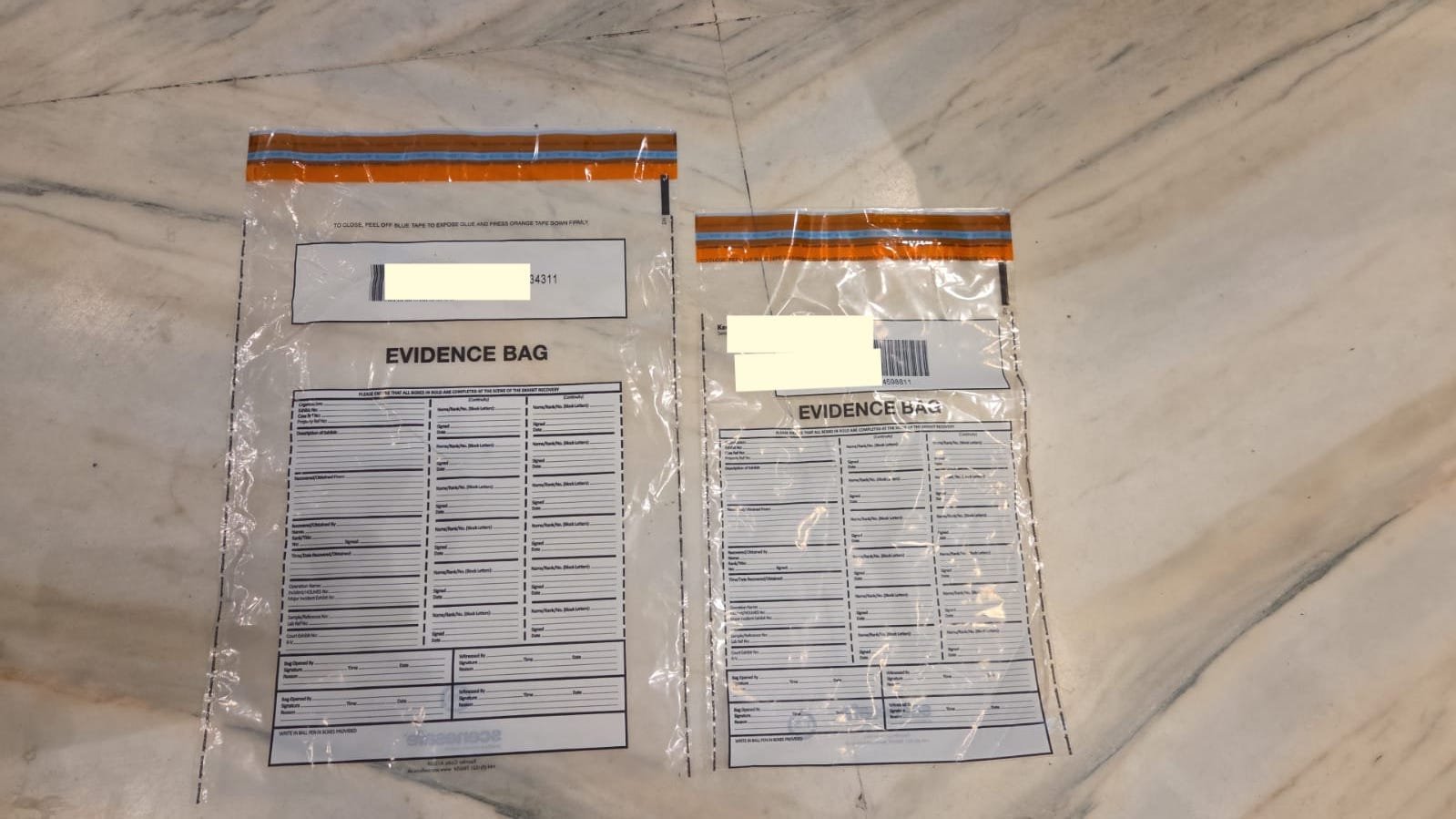
Evidence Bag Technical Specifications Introduction
Evidence bag technical specifications define the dimensions, film structure, tamper-evident closure, identification fields, printing, testing and delivery requirements that suppliers must follow for a forensic or police procurement project.
In a current Middle Eastern government tender inquiry handled with a Saudi client, the requested configurations include A3 bags measuring 350 × 450 mm plus a 50 mm closure area and A4 bags measuring 250 × 350 mm plus 50 mm, both using 80 μm (3.2 mil) polyolefin or co-extruded PE construction.
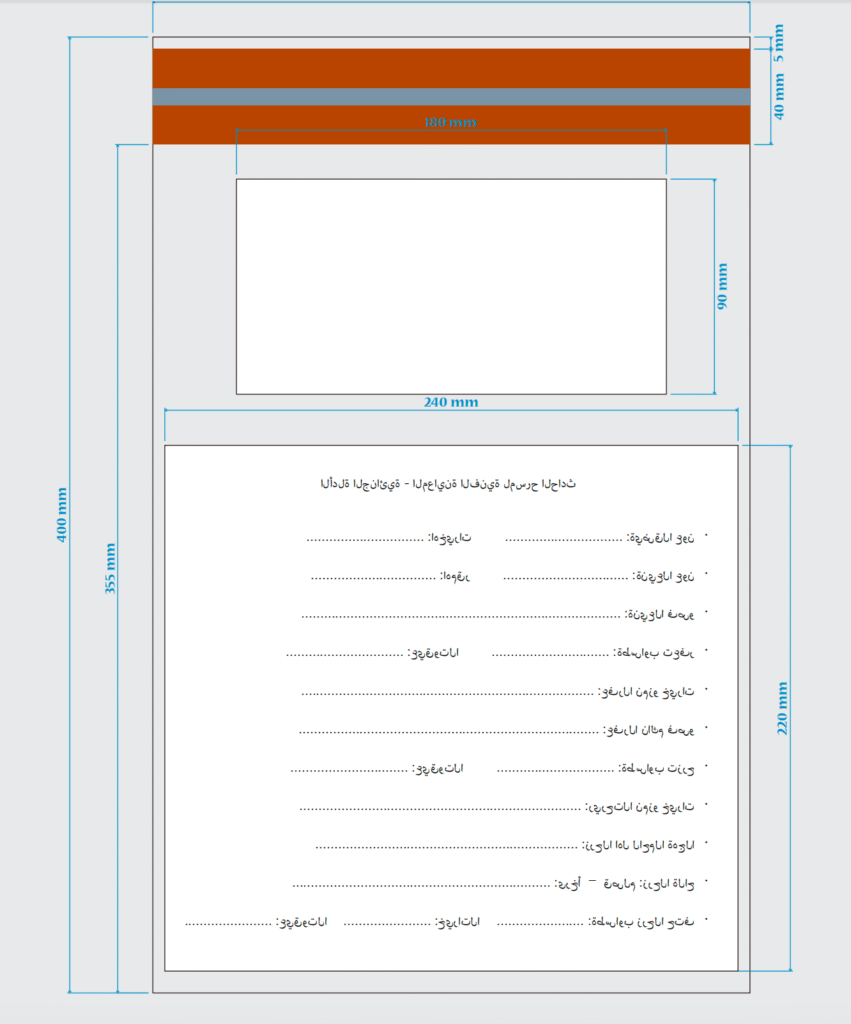
Additional requirements cover a Level 4 security seal, transparent and writable-panel versions, Arabic–English printing, waterproof and tear-resistant performance, glove-friendly opening, sequential numbering, barcodes and detachable receipts. These parameters are project-specific and must be confirmed through approved artwork, physical samples and documented testing before production.
What Do Evidence Bag Technical Specifications Include?
Evidence bag technical specifications are the measurable material, dimensional, security, identification, printing, testing and delivery requirements used to manufacture and evaluate bags for controlled evidence handling. For a forensic evidence bag tender, these requirements should be stated as verifiable parameters rather than general descriptions such as “high quality,” “heavy duty” or “secure.”
| Specification Area | Information to Confirm | Project Example |
|---|---|---|
| Dimensions | Finished width, length, usable area, sealing lip and tolerances | A3: 350 × 450 + 50 mm; A4: 250 × 350 + 50 mm |
| Film and thickness | Polyolefin, co-extruded PE, film construction and thickness tolerance | Nominal thickness: 80 μm / 3.2 mil |
| Layout and versions | Transparent area, writable panel, warning text and information fields | Transparent and writable-panel versions with Arabic–English layout |
| Logo and colors | Authorized logo, Pantone or CMYK references, number of colors and print position | Government or police logos require written authorization |
| Security closure | Seal width, tamper indication, activation conditions and testing protocol | Tender-defined Level 4 tamper-evident security seal |
| MOQ | Minimum quantity by size, artwork, material and seal configuration | EcoSecurityTape can evaluate custom orders from 5,000 bags |
A qualified police evidence bag supplier should confirm whether the specifications apply to every bag version or separately to each size and artwork. For example, an order containing A3 and A4 bags, transparent and writable-panel versions, or different Arabic and English layouts may involve multiple production configurations rather than one combined quantity.
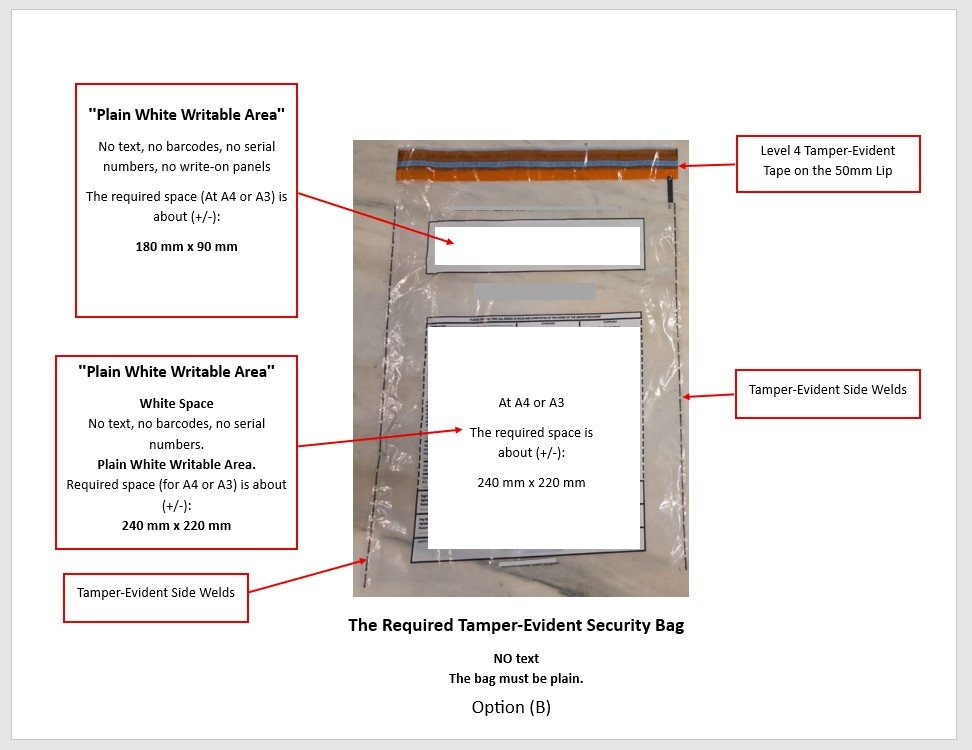
EcoSecurityTape can support selected custom evidence bags from an MOQ of 5,000 pieces per approved specification, subject to the dimensions, film, security closure, printing and sample requirements. This is more flexible than the 10,000-piece starting quantity commonly encountered in customized evidence-bag projects. However, the final MOQ should be confirmed after the artwork and Level 4 seal requirements have been reviewed, because specialized materials, variable data and different bag versions can affect production setup.
The specification table should become part of the supplier’s quotation, approved artwork and quality-control documents. This gives the buyer measurable criteria for comparing tamper evident evidence bags, approving samples and inspecting the final delivery.
Bag Dimensions, Usable Area and Closure Design
For a forensic evidence bag tender, dimensions must be defined by an approved technical drawing rather than by the labels “A3” or “A4” alone. In this Saudi project, the requested formats are 350 × 450 mm plus a 50 mm closure area and 250 × 350 mm plus 50 mm. The smaller-bag drawing shows a 250 mm width, 400 mm overall height, a 40 mm security band and a 5 mm upper area. The buyer and police evidence bag supplier should therefore confirm whether 50 mm means the complete closure section, a flap containing the security seal, or an addition to the usable bag length.
Evidence bag technical specifications should distinguish finished external dimensions from internal usable space. Side-seal width, bottom-seal position, tolerances and the area occupied by the closure reduce the space available for evidence. The selected size must also accommodate the evidence, writable panel, identification label and archive box. Packing quantities per bundle and carton should be checked against bag dimensions, film thickness and delivery requirements.
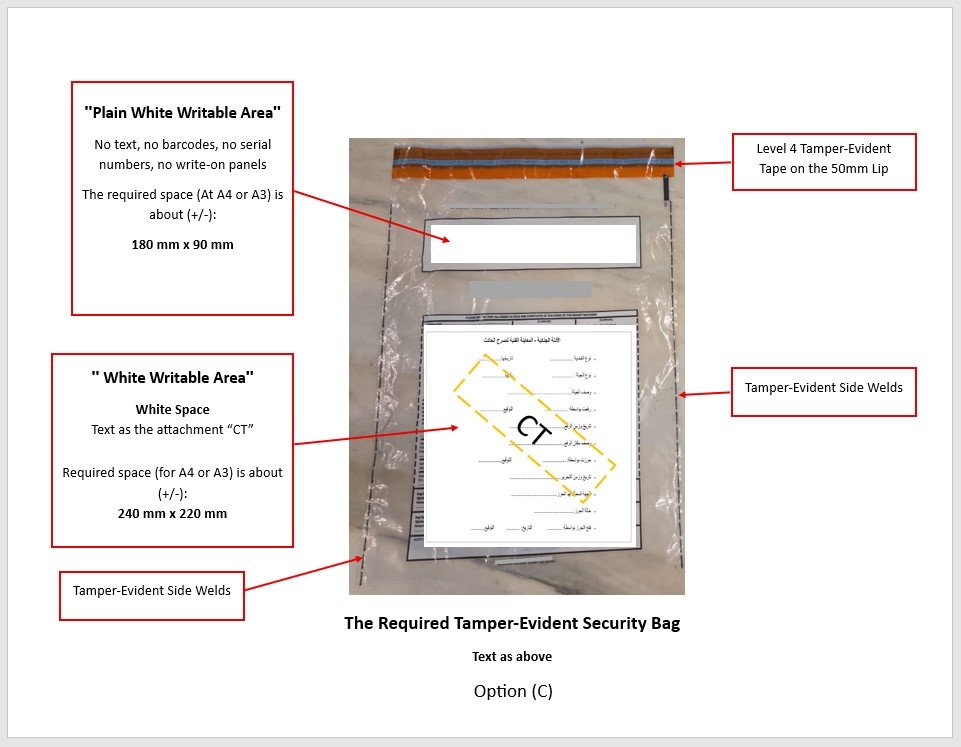
Arabic–English custom evidence bags require additional artwork control. Arabic runs from right to left, so headings, field labels, dotted writing lines, punctuation and mixed-language text cannot simply follow an English left-aligned template. Arabic content should be checked by an authorized native-language reviewer, with fonts embedded or converted to outlines before printing. Logos, sequential numbers, barcodes and detachable receipts must also remain clear of seals, welds and trim lines.
These checks ensure that tamper evident evidence bags fit the intended contents, remain practical to label and seal, and match the approved tender drawing before sampling and mass production.
Film Material, Thickness and Physical Performance
Film selection should depend on the evidence, handling conditions and tender test methods rather than on a material name alone. For the current Saudi forensic evidence bag tender, the requested construction is 80 μm (3.2 mil) polyolefin or co-extruded PE. The buyer and police evidence bag supplier should clarify whether 80 μm is a nominal or minimum thickness, the permitted tolerance, the measurement method, and whether it applies to each wall or the complete two-layer bag.
Evidence bag technical specifications should also define transparency or opacity, tensile and tear resistance, side- and bottom-seam strength, and the required water-resistance test. “Waterproof” should not remain an undefined claim: the tender should state the exposure conditions, test procedure and acceptable result. Samples should also be tested under expected low-temperature, high-temperature and storage conditions, which can affect film flexibility, seals and printing.
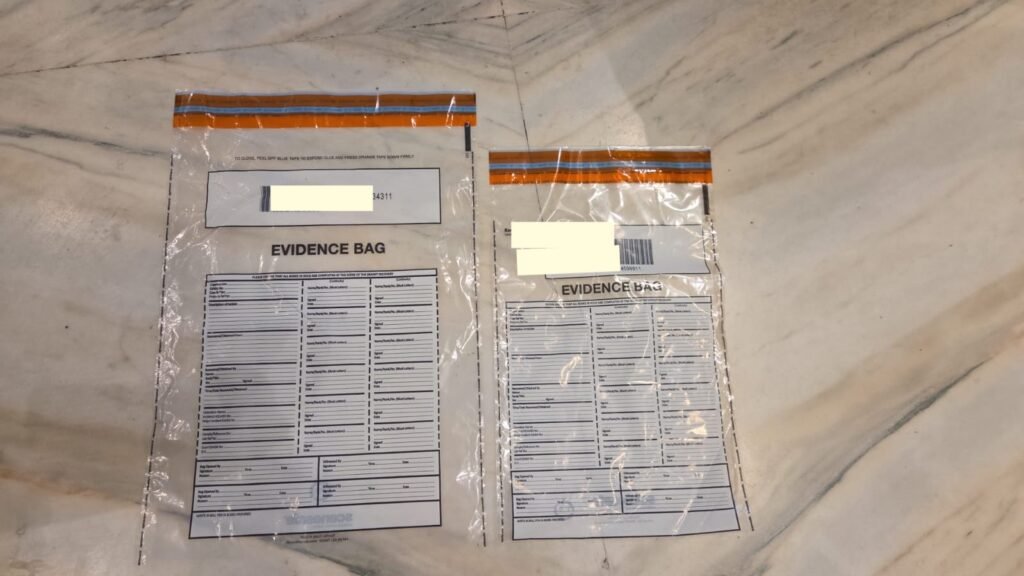
For these custom evidence bags, anti-blocking performance is important. Operators wearing nitrile gloves should be able to locate and separate the opening quickly without touching the inner surface or damaging the Level 4 closure. This should be verified using production-representative samples.
Plastic tamper evident evidence bags are not suitable for every evidence type. The National Institute of Justice advises against keeping wet or moist biological evidence in plastic for extended periods because this can promote bacterial growth, contamination and DNA degradation. Needles, blades and other sharps require a rigid, closable and puncture-resistant container rather than a flexible bag, as reflected in CDC sharps-handling guidance.
Level 4 Tamper-Evident Security Seal Requirements
Level 4 should be treated as the security grade specified for this forensic evidence bag tender, not as a universally standardized classification. Within this project—and in many supplier-specific classification systems—Level 4 represents the highest available tamper-evident configuration and normally carries the highest cost. However, the buyer must still identify the referenced standard, tender definition or test protocol before comparing quotations.
Evidence bag technical specifications should state what must happen after an unauthorized opening attempt. Required responses may include visible warning text, a color change, adhesive residue, film distortion or another irreversible indication. The buyer and police evidence bag supplier should agree on tests involving heat, freezing, solvents and mechanical peeling, together with application pressure, operating temperature and the time required for the seal to reach its final bond strength. The specification should also confirm whether temperature indicators, VOID messages, Arabic–English warnings or non-resealable construction are required, and whether the film, adhesive, printing and writable panel are compatible.
The highest security grade is not automatically the best commercial choice. Buyers of custom evidence bags, tamper evident evidence bags and security cash bags should select the seal according to the threat level, handling process, verification method, storage environment, budget and tender requirements. A lower configuration may be sufficient for controlled internal transport, while higher-risk evidence transfers may justify Level 4. Buyers can contact an EcoSecurityTape project manager to compare suitable security-seal options before requesting samples or quotations.
Transparent, Writable-Panel and Bilingual Printed Versions
A forensic evidence bag tender may require more than one visual format because evidence visibility, privacy and handwriting requirements vary by department. Transparent bags allow officers to inspect the contents without opening the package, while writable-panel bags provide a controlled area for recording case and chain-of-custody information.
| Version | Typical Purpose | Details to Confirm |
|---|---|---|
| Transparent bag | Visual inspection without opening | Film clarity, privacy requirements and printed coverage |
| Writable-panel bag | Recording evidence and custody information | Panel size, field layout, writing instrument and abrasion resistance |
Arabic–English custom evidence bags require a defined information hierarchy. Arabic is read from right to left, while English is read from left to right. Headings, warning statements, evidence numbers, case numbers, signatures and dotted writing lines must therefore be aligned separately. Both versions remain tamper evident evidence bags; the difference concerns visibility and information recording rather than the security function.
The buyer should provide approved wording and confirm which language has priority. Writable panels should be tested with the specified permanent marker, ballpoint pen or other writing instrument, including resistance to water, rubbing and alcohol.
EcoSecurityTape can prepare a preliminary artwork layout at no additional design charge for Arabic, English, Russian, Spanish and other requested languages when the buyer provides the logo, final text, dimensions and required fields. Language accuracy and legal wording must be approved by the buyer or an authorized native-language representative.
Government emblems, police identifiers, department names and protected artwork will only be used after valid written authorization has been provided. This requirement applies to samples and mass production and should be recorded in the evidence bag technical specifications reviewed with the police evidence bag supplier.
Sequential Numbers, Barcodes and Detachable Receipts
A sequential number or barcode supports identification, but it does not by itself create a complete digital chain-of-custody system. In a forensic evidence bag tender, the buyer must distinguish the printed identifier from the database and operational process used to assign, activate, scan, transfer and close an evidence record.
| Identification Element | Primary Function |
|---|---|
| Bag serial number | Gives each bag a unique human-readable identifier |
| Barcode or QR code | Provides machine-readable data for scanning |
| Detachable receipt | Repeats the identifier for collection or handover records |
| Backend system | Stores, activates, verifies and reports evidence movements |
Evidence bag technical specifications should define the number length, permitted letters, starting and ending range, barcode type, encoded data and human-readable text. For 100,000 custom evidence bags using a fixed six-digit format, the range could be 000001–100000. A department prefix can also be added, such as XJ00001–XJ90000, provided that its meaning and uniqueness are confirmed.
One-dimensional barcodes and QR codes can be produced after the buyer approves the data structure, printed size, quiet zone, error-correction requirement and scanning distance. Where a detachable receipt is required, the buyer should confirm whether it repeats the bag number and barcode exactly.
The police evidence bag supplier must also define duplicate-data checks, missing or incorrect number controls, authorized reprint procedures and voided-number handling. The tender should state who generates the data and whether a CSV, spreadsheet or database-import file is required. These controls help tamper evident evidence bags support traceable custody workflows without presenting a printed code as a complete evidence-management platform.
Samples, Artwork and Pre-Production Approval
Samples for a forensic evidence bag tender should be identified by purpose because a reference bag, functional sample and approved production sample do not provide the same evidence of compliance.
| Sample Type | What It Demonstrates |
|---|---|
| Existing structural sample | General film, bag construction and security-seal capability |
| Functional sample without official marks | Dimensions, sealing, handling and physical performance |
| Authorized custom-printed sample | Approved language, logo, layout, numbering and barcode design |
| Final pre-production sample | The materials, artwork and process intended for mass production |
The buyer and police evidence bag supplier should record which characteristics each sample is intended to verify. Testing may cover finished dimensions, 80 μm thickness, anti-blocking performance, handling with nitrile gloves, tamper response, transparency, writable-panel performance, bilingual print accuracy, serial-number and barcode readability, receipt removal, water resistance, tear resistance and seam strength. Approval should state whether the buyer accepts only the appearance or also approves the material, security seal and production process.
Official government artwork, emblems, department identifiers and operational numbering systems will not be copied or manufactured without valid written authorization. During the tender stage, EcoSecurityTape can prepare a preliminary design after the customer provides the tender documents, required text, logos and evidence of its authorized role. Formal production of custom evidence bags will not begin until the required authorization and final written artwork approval have been received.
Customized samples normally require a development fee because project-specific materials, printing setup, security seals and testing must be prepared. When the subsequent order reaches the quantity agreed in the quotation, the eligible sample fee can be deducted from the bulk-order payment. This conditional credit free sample policy helps both parties verify the evidence bag technical specifications before producing tamper evident evidence bags at scale.
Quality Inspection and Tender Acceptance Criteria
Government procurement should not accept “good quality” as an inspection criterion. For a forensic evidence bag tender, each requirement must have a measurable tolerance, test method, sampling quantity, acceptance limit and inspection record. The buyer and police evidence bag supplier should agree on these conditions before approving mass production.
The recommended workflow begins with a small pilot run using the intended film, printing, security seal and numbering process. The buyer reviews the samples and confirms whether they satisfy the approved evidence bag technical specifications. If a sample fails, the production team should determine whether the cause relates to the material, artwork, machine settings, sealing or another process factor, implement corrective action and submit a revised sample when necessary. Mass production should begin only after written approval.
During production, batch inspections should verify dimensions and thickness, print color and registration, Arabic–English content, serial-number uniqueness and sequence, barcode grade or actual scan rate, Level 4 tamper response, bag and seam strength, water and tear resistance, and writable-panel adhesion. Sampling quantities, acceptable defect levels and inspection frequency must be stated in the tender or quality plan.
Nonconforming custom evidence bags must be segregated, recorded and excluded from the accepted delivery quantity. Scrap and authorized reprints should remain traceable by batch and number range. If a delivered batch later contains verified shortages or defects, replacement, credit or replenishment in a subsequent shipment may be arranged according to the contract and authorized numbering procedure. This reduces the buyer’s loss while maintaining control over tamper evident evidence bags and their identification records.
MOQ, Production Capacity, Packing and Delivery
For most custom evidence bags, EcoSecurityTape’s standard MOQ is 5,000 pieces per approved size and printing version. Selected projects may be evaluated from 3,000 pieces based on the bag structure, material availability, artwork setup, total order combination and expected repeat demand. Transparent and writable-panel quantities cannot automatically be combined: the police evidence bag supplier must first confirm whether they use the same dimensions, film, Level 4 closure and production setup.
For a forensic evidence bag tender, the schedule should separate artwork approval, material preparation, sample production, courier transit, mass production, inspection and final delivery. Customized samples normally require approximately 10 working days after the specifications, artwork and sample fee are confirmed. International express delivery commonly requires approximately seven additional working days, depending on the destination, customs clearance and courier service.
Bulk-production time depends on the quantity, number of versions, printing, variable data and inspection requirements. Production is generally scheduled for completion within 45 days after the final artwork, approved samples, materials, numbering data and commercial terms have been confirmed. Larger or more complex orders may require a revised schedule. Evidence bag technical specifications should also state whether inspection and delivery will occur in one batch or in stages.
Packing instructions must define the quantity per pack and carton, carton numbers, batch references, packing lists and export documents. Bulk cartons are packed and palletized for shipment, subject to the transport method and destination rules. Saudi projects should additionally confirm whether Arabic outer-carton labels, consignee references or tender-specific shipping marks are required for the tamper evident evidence bags.
How to Select a Police Evidence Bag Supplier
Selecting a police evidence bag supplier requires more than comparing unit prices or accepting a claimed security level. For a forensic evidence bag tender, the buyer should verify the company profile and manufacturing capability, material technical data, seal construction, available test reports, customized printing capability, numbering and barcode controls, sample-development process, QC plan, nonconforming-product controls, MOQ, capacity, lead time, packing and international-delivery arrangements.
The supplier should translate the tender into measurable evidence bag technical specifications covering dimensions, usable area, film thickness, Level 4 seal performance, Arabic–English artwork, serial numbers, barcodes, detachable receipts, inspection methods and acceptance criteria. Samples should represent the intended material and process, while approval records should distinguish appearance approval from approval of material, security performance and mass-production conditions. Government emblems, police identifiers and protected artwork should only be used after written authorization.
The most suitable supplier is not necessarily the one offering the highest security grade or lowest MOQ. Buyers should assess whether the proposed custom evidence bags match the evidence type, operational risk, handling workflow, verification method, budget and delivery schedule.
EcoSecurityTape supports authorized government agencies, forensic laboratories, police procurement teams and licensed contractors with specification review, sample development and the production coordination of tamper evident evidence bags. Send us the required dimensions, film structure, security-seal definition, artwork, quantity, numbering data and delivery destination for a project-specific evaluation.
For an initial evaluation, send your specifications, quantity, required security features, sample deadline, authorization documents, and destination to info@ecosecuritytape.com or WhatsApp +1 615 480 2757.
Related Articles About Evidence Bags
Explore these related guides for evidence bag selection, chain-of-custody considerations, supplier evaluation and custom procurement planning.
- Police Evidence Bags: Features, Uses & Buying Guide
- Forensic Evidence Bags: Chain of Custody, Types, and Selection Guide
- Forensic Evidence Bag Supplier Qualification Checklist for Government Buyers
- Custom Evidence Bags: A Procurement Checklist for Multiple Sizes and Designs

Focus on tamper evident packaging, free sample for test, small-batch MOQ, let’s have a talk.