What Are Camera Blocking Security Labels?
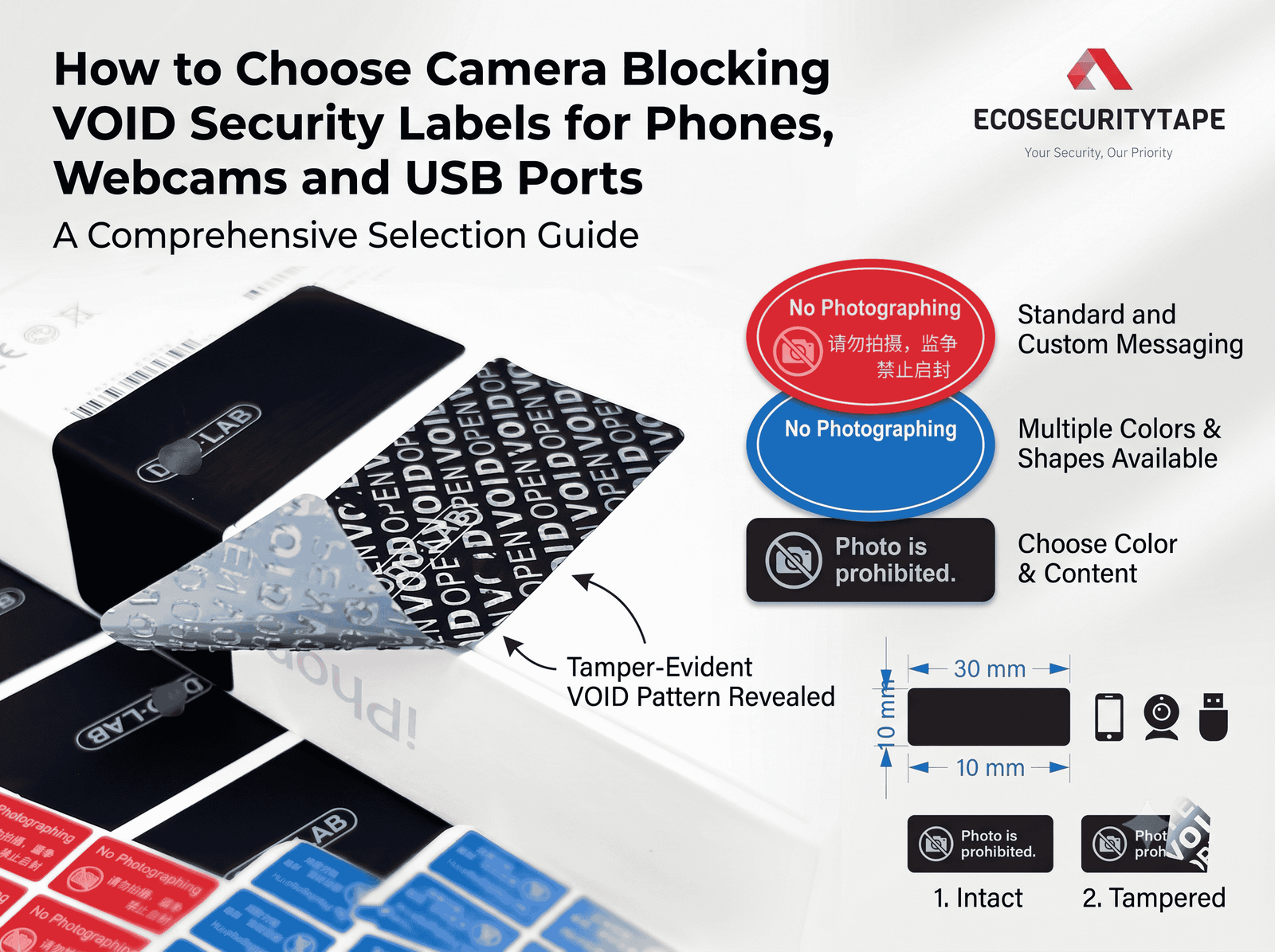
Camera blocking security labels are labels placed over selected device cameras to obstruct the lens. When a suitable tamper-evident construction is used, they can also display visible evidence of attempted removal.
These are two separate functions. A label may cover a lens without providing removal evidence, while a security material may show a VOID effect without adequately blocking the camera. Both require confirmation for the selected product.
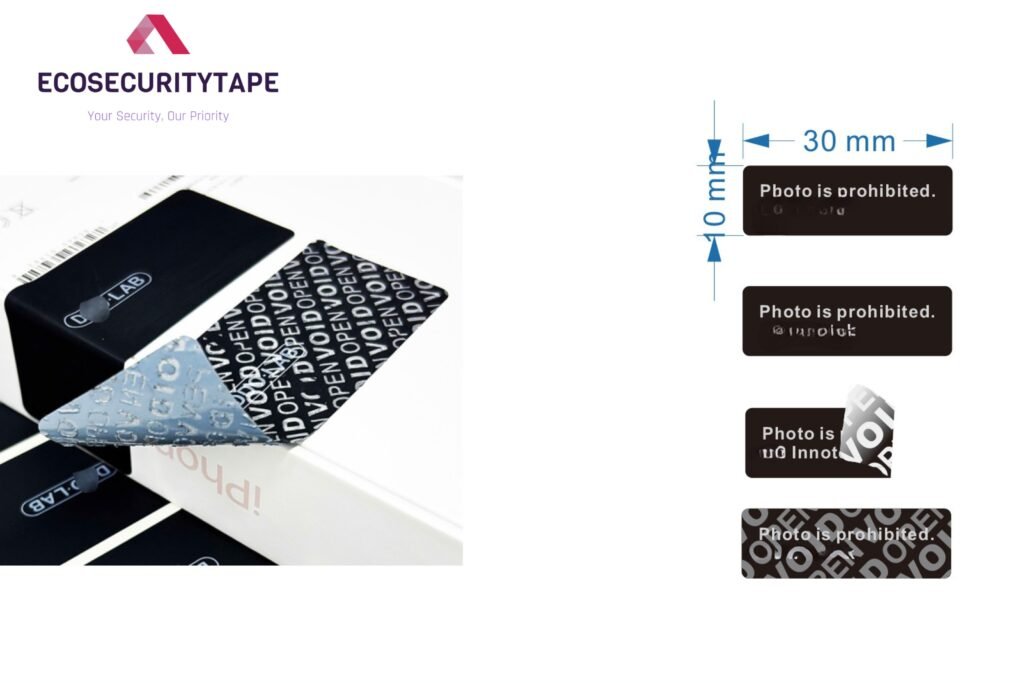
Camera blocking security labels should therefore be evaluated as a complete application. Buyers need to check the material, dimensions, camera position, contact surface and expected opening effect rather than select by printed wording alone.
EcoSecurityTape has stock products available and can provide suitable samples free of charge for customer testing. Sample transportation is paid by the buyer, with arrangements confirmed before dispatch.
For camera blocking security labels carrying a customer’s logo, our starting quantity is 1,000 labels. This is a label quantity, not 1,000 A4 sheets.
Printing and cutting can be organized on an A4-sized production layout. For suitable small dimensions, one layout can contain more than 100 individual labels. The actual yield depends on size, spacing, shape and production requirements.
This helps explain why 1,000 pieces can be a practical branded order rather than an unusually large project. It does not guarantee identical production yield for every design.
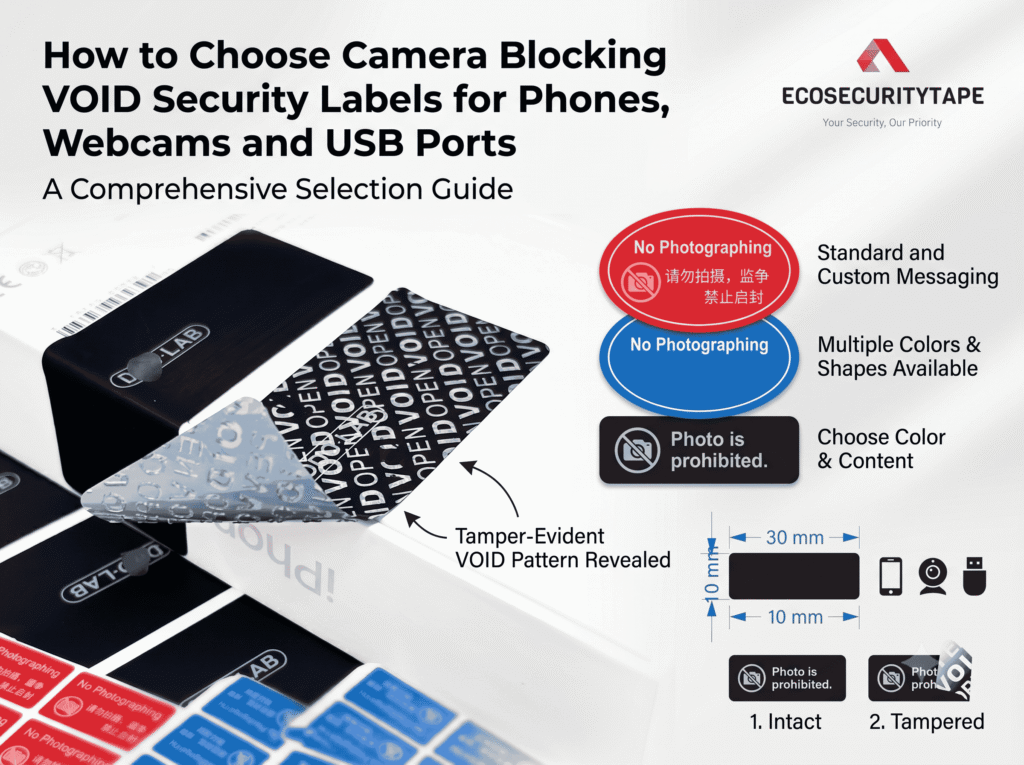
Camera blocking security labels support a defined workplace procedure. They do not disable the phone or control all cameras, microphones, connected devices or recording functions.
EST prepared this guide because customers from different countries ask about samples, coverage and visitor applications. A clear understanding of the product’s functions helps buyers plan testing and select an appropriate stock or custom option.
For camera blocking security labels, buyers should keep coverage and tamper testing as separate approval items. This makes feedback clearer when a sample performs well in one respect but not another. The approved record should identify the tested material and dimensions rather than rely only on a general product description.
Why Workplaces Use Camera Labels for Visitor Control
Workplaces consider camera blocking security labels when photography is restricted in selected areas. Possible settings include meetings, production visits, supplier inspections, research areas and other spaces where organizations manage access to sensitive visual information.
The organization should define its requirements before selecting a label. Which devices are covered, which cameras require blocking and who checks them are operational questions rather than printing decisions.
Restrictions on camera use are part of some sensitive facilities’ visitor procedures. For example, the Pantex Plant’s visitor rules on camera and wireless-device use prohibit using camera functions on devices within the plant site.
Where a workplace permits phones with covered cameras, camera blocking security labels can support visual checks and help identify attempted label removal. However, labels do not disable a device’s camera electronically or replace the facility’s own access and device-control requirements.
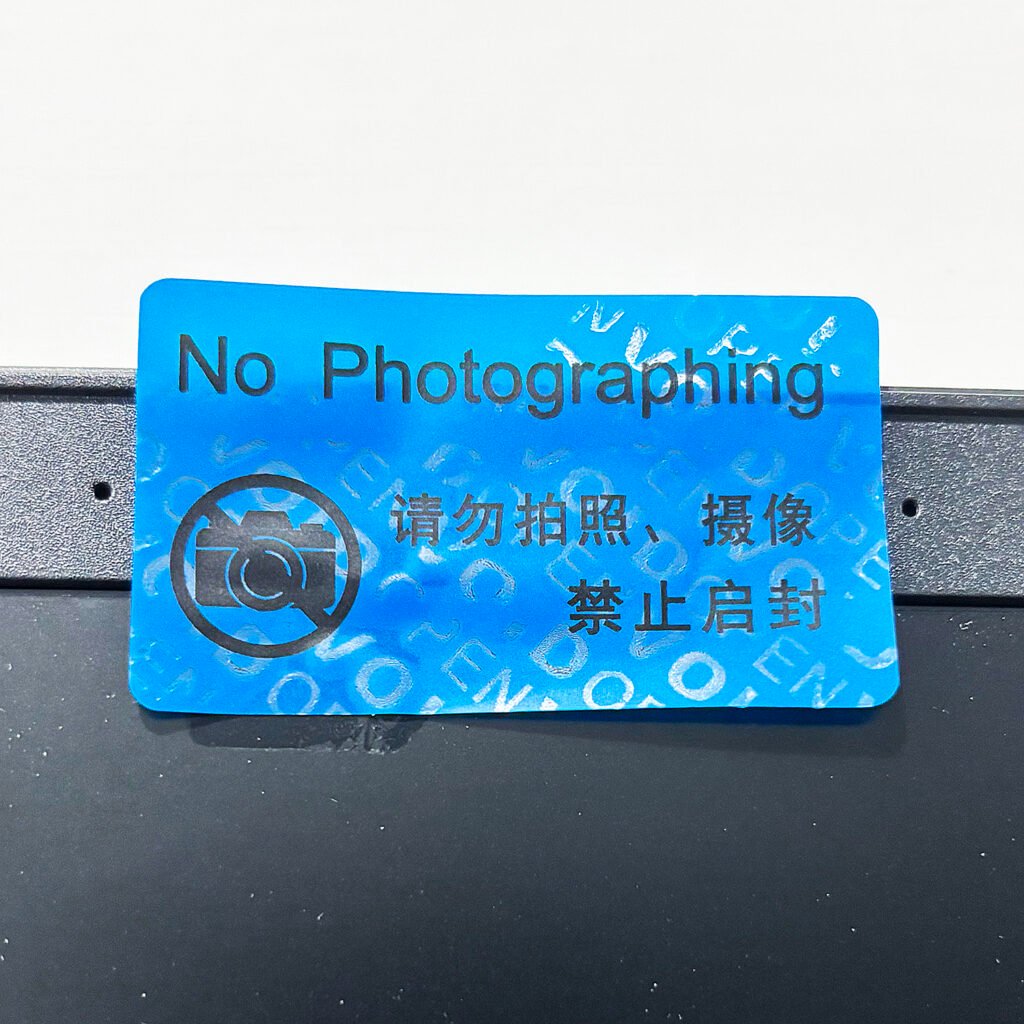
Camera blocking security labels can provide a visible indication that a visitor has followed an agreed procedure. Tamper-evident material can also help staff recognize interference with the applied label when the construction works as intended.
However, a label does not verify that every recording function has been controlled. Staff still need to follow the institution’s device and visitor procedures.
No photography security labels can carry a short reminder of the site rule. The wording should be approved by the buyer and should not promise capabilities that the material does not provide.
Camera blocking security labels may also be used for employees or contractors entering a restricted area. These are potential applications, not claims that EST has supplied every type of workplace listed here.
For occasional visits, stock labels may provide a useful testing or purchasing starting point. Buyers seeking their own branding can review a 1,000-label custom order after confirming the application.
The selected label should be practical for the personnel issuing it. A clear design is less useful if it is difficult to pick up, apply or inspect during a busy arrival period.
EcoSecurityTape recommends evaluating camera blocking security labels within the actual visitor workflow. Observe how staff identify cameras, position the label and recognize the expected removal effect.
This connects product selection with the organization’s operating procedure and helps distinguish a material issue from an incomplete device-checking process.
Before ordering camera blocking security labels, identify who makes the final specification decision. Purchasing staff may review cost, reception staff assess handling, and the workplace administrator defines the camera restrictions. Combining those inputs can prevent an order that matches the artwork but does not support the intended visitor procedure.
Match Label Size to Camera Position and Coverage
Selecting camera blocking security labels starts with identifying the cameras that need coverage. Phones can differ in lens arrangement, surface shape and the relationship between cameras, sensors and protective cases.
A single compact label should not be assumed to cover every camera on every device. Buyers should provide representative device photos or model information and identify the required coverage.
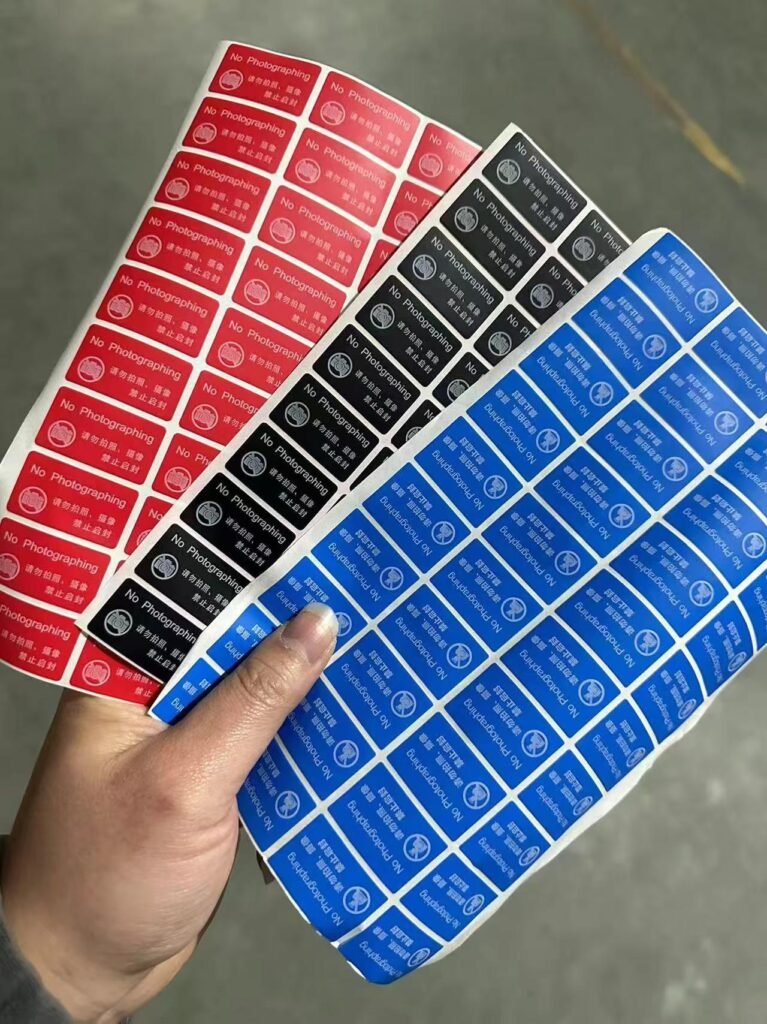
For phone camera blocking labels, confirm whether the adhesive contacts the device itself, a protective film or a case. These positions can involve different surfaces and available contact areas.
| Camera Arrangement | Coverage Question | Application Check |
|---|---|---|
| Front-facing camera | Which lens opening requires blocking? | Review nearby screen and sensor areas |
| Single rear camera | Does the label cover the full lens area? | Check surrounding contact surface |
| Multiple rear cameras | Which lenses are included in the requirement? | Confirm coverage of each required lens |
| Raised camera module | Can the label fit the shape consistently? | Inspect contact, bridging and edge fit |
| Device with a case | Where will the label adhere? | Test the actual case or exposed surface |
Camera blocking security labels should have sufficient dimensions for the intended lens coverage and application. A larger label is not automatically better if it obstructs features the buyer wants to preserve.
Check whether the proposed position affects a flash, sensor or another function. Device behavior should be tested rather than assumed from the label outline.
Test camera blocking security labels on representative phones using the organization’s intended procedure. Verify the coverage and whether placement remains consistent across operators.
For custom sizes, an approved drawing should identify the dimensions and outline. Actual-size references help buyers understand the design more clearly than enlarged artwork alone.
Successful coverage on one phone does not approve every model. Keep a record of tested devices and note which arrangements require a different label or application method.
Tamper Evidence, Removal Effects and Device Surfaces
The removal performance of camera blocking security labels depends on their construction and application surface. Buyers should distinguish lens coverage, visible tamper evidence, adhesive residue and surface condition.
Non-transfer constructions principally show removal evidence on the label without transferring a prominent security message onto the device. Transfer constructions may leave a marking on the surface, depending on the selected material.
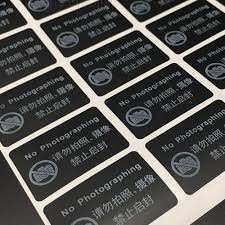
For tamper evident camera stickers, the expected effect should be demonstrated before approval. Staff need to understand the appearance of both an intact label and one that has been disturbed.
Camera blocking security labels should not be approved only because a VOID message appears clearly on a supplier’s demonstration surface. The intended glass, coating, protective film or case requires its own evaluation.
Non-transfer does not automatically mean residue-free. A label can keep its security message on the face while still leaving adhesive traces on a particular surface.
Likewise, clean-looking removal does not establish that the required evidence appeared. Inspect the label and device separately.
Camera blocking security labels may be attached for a short visit or a longer period. Buyers should identify the expected duration so testing reflects their operation rather than only an immediate peel.
Application conditions and handling also matter. The buyer should describe any relevant exposure or device-use requirements before selecting the construction.
EST can review these requirements and provide suitable stock samples for testing. The sample’s material and effect should be identified so feedback relates to a specific product.
Approval of camera blocking security labels should state the accepted coverage, removal result and device-surface condition. This gives the buyer a useful reference for repeat supply without suggesting universal compatibility with every phone.
If several devices are included, maintain a test list for camera blocking security labels rather than generalizing from one successful example. Record where each label was attached and how long it remained in place. Photographs before and after removal give the buyer and EST a more useful comparison reference.
Plan Label Issuing, Visitor Batches and Departure Checks
A visitor process for camera blocking security labels should identify who issues the labels, who applies them and who checks the result. These responsibilities should be established before a larger purchasing project.
At arrival, staff can follow the organization’s approved device procedure and identify the cameras requiring coverage. The label position should match the tested application rather than be improvised for every visitor.
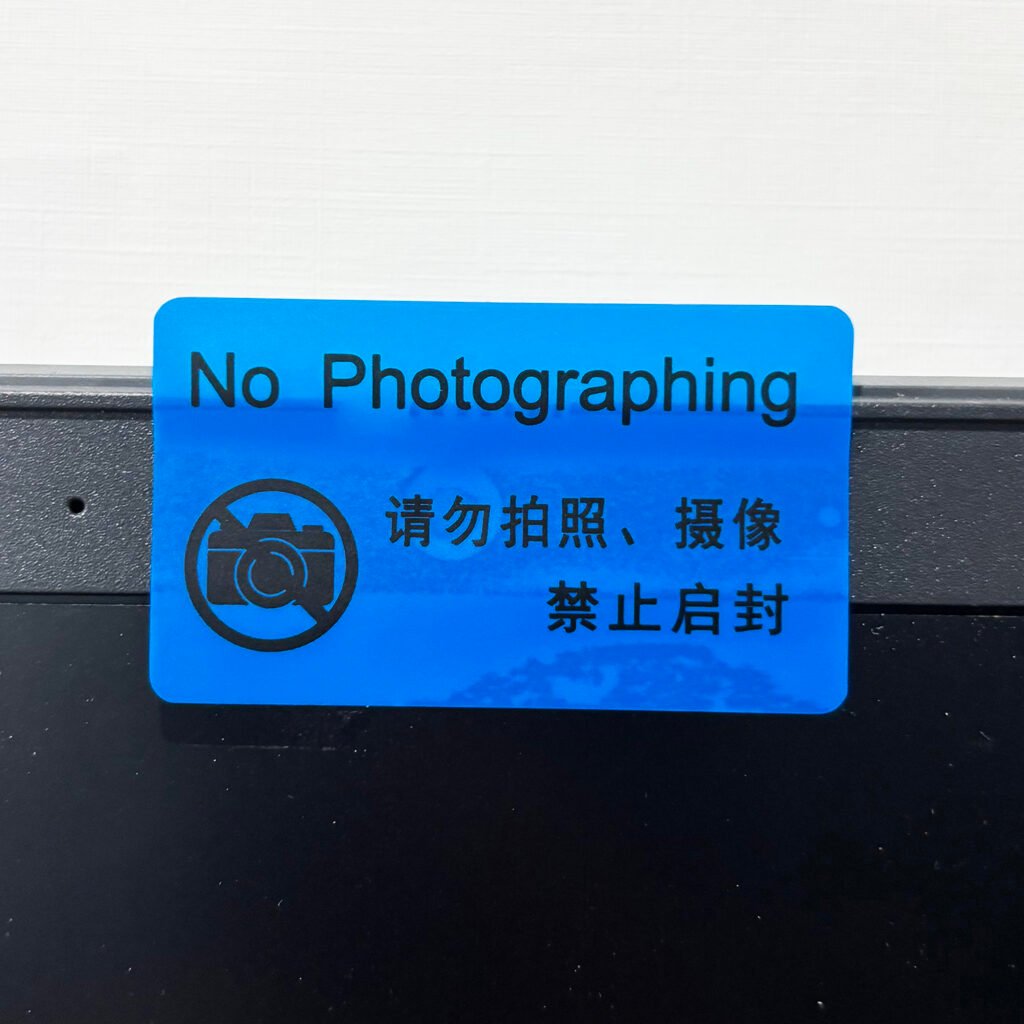
Camera blocking security labels should then be checked before entry. Staff can confirm that the required lenses are covered and that the label appears intact.
During the visit, any further checks should follow the institution’s procedure. A label alone does not establish that a person has complied with all device restrictions.
Visitor camera control labels can include an approved color, date or batch reference to help internal identification. However, color alone does not prove that a label has not been replaced.
Camera blocking security labels with individual identifiers require a clear purpose. Decide whether the identifier is recorded against a visitor, device or issued quantity before adding variable data.
For departure, establish how labels will be checked and removed. The organization should identify who handles removal and how residue or device concerns are reported.
Avoid assuming that the same procedure suits every device owner or workplace. The buyer approves the operational rules, while EST supports the agreed label specification.
Stock camera blocking security labels can help evaluate the workflow before introducing branding. Observe application time, clarity and handling under representative arrival conditions.
A purchasing estimate should distinguish the number of visitors from the number of labels required. Devices may need more than one label, and operational allowance should be based on actual use rather than an assumed one-label-per-person rule.
Organizations using camera blocking security labels should also decide how damaged, unused or removed pieces are handled. A simple record of issued quantities and unexpected problems can help estimate future consumption. The buyer should define the process without assuming that a printed batch code provides automatic tracking or inspection.
Custom Warning Text, Logos and Sample Testing
EcoSecurityTape keeps camera blocking security labels in stock and can provide suitable samples free for customer evaluation. Buyers should confirm the available specification and expected effect before shipment.
Sample transportation is paid by the customer. Options include an eligible DHL or other courier collect account, collection through a Chinese freight forwarder, or transportation arranged by EST with freight paid to us.
For branded camera blocking security labels, the MOQ is 1,000 pieces. Stock purchasing requirements are confirmed separately; the custom-logo minimum should not automatically be applied to every available stock product.
The printing layout helps explain this quantity. Depending on dimensions and spacing, an A4-sized layout can contain more than 100 small labels for printing and cutting. Larger sizes or different shapes may yield fewer pieces.
Camera blocking security labels are counted as individual labels, not production sheets. The final quotation identifies the dimensions, quantity and supplied format.
Send a vector logo, proposed warning text, colors and language requirements. EST can prepare a preliminary design free of charge for the customer’s review.
No photography security labels should use wording that fits the buyer’s actual policy. Approve translations and avoid making the printed warning so crowded that it becomes difficult to read.
Camera blocking security labels with a custom logo still need material testing. Branding does not establish coverage, residue behavior or the reliability of the removal effect.
Use samples to check printing clarity, actual-size placement and device compatibility. Stock samples may demonstrate the construction without matching the final custom outline or artwork.
After artwork approval, EST prepares the PI and confirms payment, production and shipment arrangements. Project-specific terms should be recorded clearly rather than inferred from a previous product order.
For repeat orders of camera blocking security labels, retain the approved artwork and material specification. Any change in dimensions, warning language or printing should be reviewed before reuse. A familiar logo does not establish that the new label has the same construction or fits the previously tested devices.
Real U.S. and Turkey Inquiries: Turning Requirements into a Quotation
Recent inquiries for camera blocking security labels show why requirements should be organized before quotation. Buyers often begin with a general request for phone labels, but the actual project needs more detail.
A U.S. customer contacted EST about phone camera-blocking labels. This is an inquiry example, not a claim that production or delivery has occurred.
A Turkish customer also consulted EST and tested samples. The sample stage should not be described as successful approval or a completed bulk order unless those outcomes are separately confirmed.
For camera blocking security labels, these cases highlight the value of asking about devices, required lenses, contact surfaces and removal expectations early in the discussion.
An RFQ should include device models or photos, coverage requirements, dimensions, quantity, warning text, logo, colors and delivery country. Include expected attachment time and acceptable residue where relevant.
Phone camera blocking labels may need more than one size if the project includes different camera arrangements. Buyers should list quantities by variant rather than provide only a total.
For logo-printed camera blocking security labels, the starting quantity is 1,000 pieces. How that quantity applies to multiple designs is confirmed during quotation.
The customer provides a vector logo and approves the proposed layout. EST then prepares the PI, with production beginning after receipt of the agreed payment.
Payment stages and shipment arrangements are recorded in the PI. Shipment before settlement of the remaining balance can apply where expressly agreed for the order.
The U.S. and Turkish inquiries help explain why camera blocking security labels should be assessed as a device-specific application and visitor-management tool, rather than ordered only by color or a generic product photograph.
Customers testing camera blocking security labels should send specific observations rather than only requesting a stronger adhesive. Coverage, edge contact, visible opening evidence and residue may involve different requirements. Explaining the problem with photographs helps EST review a suitable option while preserving the device-surface and handling requirements already agreed.
FAQs About Camera Blocking Security Labels
Q1: Will one label cover every camera on a phone?
No universal fit should be assumed. Camera blocking security labels must be matched to the required front or rear lenses and device arrangement. Some phones may need several labels or another size. Provide device photos and test the intended position before approving supply.
Q2: Do these labels also show removal evidence?
An appropriate tamper-evident construction can show disturbance, but the effect must be confirmed for the selected product. Camera blocking security labels should be checked for both lens coverage and removal evidence. An ordinary opaque sticker does not automatically have a security function.
Q3: Will removal leave residue or affect the surface?
Results depend on material, contact surface, duration and conditions. Test camera blocking security labels on representative devices, protective films or cases. Non-transfer does not guarantee residue-free removal. Record adhesive traces and any surface changes separately from the security effect.
Q4: Can I customize the logo, dimensions and wording?
Yes, EST can review custom artwork and specifications. Branded camera blocking security labels start at 1,000 pieces. Send a vector logo and required text for free preliminary design. The quantity refers to labels, not A4 sheets, and multi-design arrangements need confirmation.
Q5: Can I request free samples?
Yes. Suitable stock samples can be provided free, with transportation paid by the buyer. Use an eligible courier collect account, a Chinese freight forwarder or shipping arranged by EST. Confirm the sample construction and testing scope, particularly when the final design differs.
Q6: What information is needed for a quotation?
Provide device photos, required lens coverage, contact surface, label dimensions, quantity, logo, wording and delivery country. Explain the visitor process and removal requirements. EST reviews camera blocking security labels against those details before confirming stock options or a custom production arrangement.
Conclusion: Combine Camera Labels with a Clear Visitor Procedure
Camera blocking security labels work best when coverage, device compatibility and removal evidence are evaluated alongside a clear workplace procedure. The label is one part of visitor management, not a control for every recording function.
EcoSecurityTape offers stock products and suitable free testing samples, with transportation paid by the customer. Logo-printed orders start at 1,000 individual labels. A4-sized layouts can accommodate more than 100 pieces for suitable designs, although actual production yield varies.
The U.S. inquiry and Turkish sample-testing project illustrate the importance of confirming requirements before bulk purchasing.
Send your device photos, coverage needs, quantity, vector logo and warning text to discuss camera blocking security labels or request samples and a quotation.
Email: info@ecosecuritytape.com
WhatsApp: +1 615 480 2757
Contact EcoSecurityTape
Download the Product Catalog

Focus on tamper evident packaging, free sample for test, small-batch MOQ, let’s have a talk.