RFID Labels with Tamper Evident Features for Secure Tracking
What Is an RFID Label?
Definition
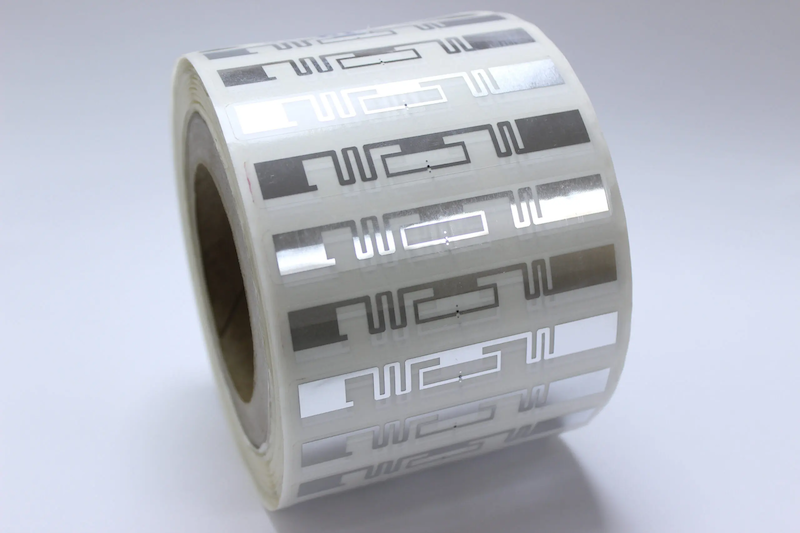
An RFID label (Radio Frequency Identification label) is a wireless identification medium that integrates a microchip and an antenna. It enables contactless data transmission through radio frequency signals to identify objects and track information, allowing data to be read without manual, close-range scanning.
Key Components
An RFID label typically consists of four core components: a chip (for data storage), an antenna (for transmitting and receiving RF signals), a substrate (the physical carrier), and an adhesive layer (for attachment). Some high-end RFID labels also include protective coatings for enhanced durability.
Working Principle
An RFID reader emits a radio frequency signal that activates the RFID label. The chip then responds by transmitting the stored data back to the reader, which decodes the information. This process enables fast, contactless, and batch identification of multiple items simultaneously.
Advantages Over Traditional Barcodes
Compared with traditional barcodes, RFID labels offer a longer reading range (up to 10 meters or more), can be read through non-conductive materials, support simultaneous bulk reading, provide larger and rewritable data storage, and deliver stronger resistance to harsh environments.
Market Status and Development Trends
The global RFID label market exceeded USD 20 billion in 2024. Driven by the growth of the Internet of Things (IoT) and smart manufacturing, the market is experiencing a compound annual growth rate (CAGR) of over 15%, with increasing adoption across security, logistics, and retail sectors.
What Is a Tamper-Evident RFID Label?
Definition
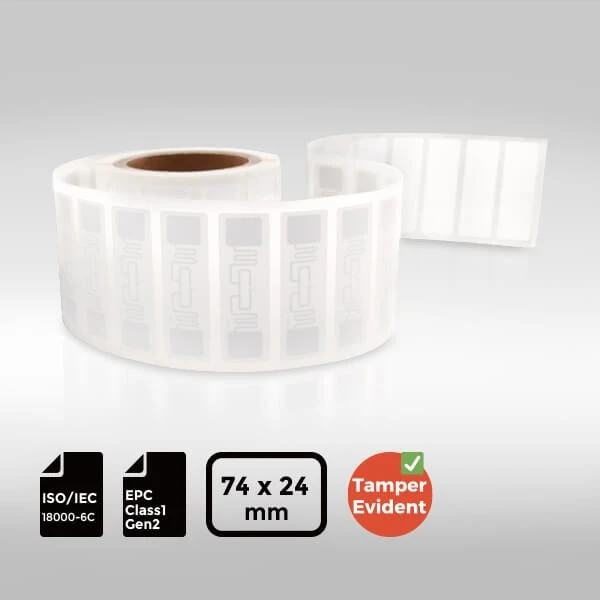
A tamper-evident RFID label is a specialized RFID label that integrates anti-tampering technology on top of standard RFID functionality. Once the label is illegally opened, peeled off, or tampered with, it will immediately trigger physical damage or data failure and leave clear, irreversible evidence, ensuring a unique and permanent bond between the label and the tagged item.
Tamper-Evident Mechanisms
Tamper evident RFID labels typically use one or a combination of the following mechanisms:
- Physical Tamper Evidence:
Uses materials or structures such as destructible paper, VOID patterns, or irreversible adhesives. When removed, the label breaks apart or leaves visible warnings like “VOID” or “TAMPERED,” making reuse impossible. - Data-Level Protection:
The RFID chip incorporates encryption or security logic. Once data is written, it cannot be freely modified; any tampering attempt may trigger data locking or deletion. - Dual Tamper Protection:
Combines physical destruction and data encryption, offering a higher security level against unauthorized removal, transfer, or reuse.
Differences from Standard RFID Labels
Standard RFID labels focus solely on identification and tracking. In contrast, tamper-evident RFID labels add a critical security layer, preventing label transfer, duplication, or manipulation at both the physical and data levels.
Typical Application Scenarios
Tamper-evident RFID labels are widely used in high-security environments, including high-value asset tracking, hazardous material management, confidential document control, medical consumables traceability, and cold-chain logistics monitoring—where data integrity and physical security are essential.
Common Applications of RFID Tamper-Evident Labels
Logistics and Supply Chain
High-value goods warehousing and distribution:
A premium smartphone brand applies destructible tamper evident RFID labels to each device package in overseas warehouses. The labels are linked to the handset serial number and authorized distributor data. Using UHF readers, the company completes full-warehouse inventory checks within 1 hour (compared to 8 hours with manual counting) while tracking shipment routes in real time. If a label is damaged or goods enter unauthorized regions, the system immediately triggers diversion alerts, reducing annual gray-market losses by over RMB 3 million.
Cold-chain logistics:
An imported fresh-food company equips frozen seafood containers with tamper-evident RFID labels integrated with temperature and humidity sensors. The labels record conditions every 30 minutes (from –25°C to 10°C) and transmit data wirelessly to the management platform. If containers are illegally opened during transit, the label is physically damaged and historical temperature data is locked—ensuring traceability, preventing falsification, and avoiding food-safety disputes.
Pharmaceuticals and Healthcare
Drug traceability:
A pharmaceutical manufacturer applies HF tamper-evident RFID labels to the smallest sales units (medicine boxes) for prescription drugs such as cephalosporins. Labels store batch numbers, expiration dates, production workshops, and distribution regions—fully compliant with China GSP and EU FMD requirements. Pharmacies verify authenticity at sale, while regulators trace batch circulation with one click. As a result, counterfeit-related complaints dropped from 23 per year to zero.
Medical consumables management:
Hospitals attach irreversible adhesive tamper-evident RFID labels to implantable orthopedic consumables (e.g., artificial joints, spinal systems). Labels bind patient name, admission number, surgery time, and unique item codes. Nurses verify before surgery; post-operation, the biocompatible label remains with the implant. During follow-ups, authorized readers retrieve data quickly—eliminating reuse risks and enhancing patient safety.
Retail and Luxury Goods
Luxury authentication and provenance:
Luxury brands embed miniaturized, encrypted tamper evident RFID labels within hardware components or inner leather of bags and watches. Labels store brand codes, factory data, and sales regions. Consumers verify via official apps; any damage or data mismatch triggers an immediate “non-authentic risk” alert. Stores adopting this solution reported up to 80% improvement in consumer trust.
Anti-diversion for premium apparel and cosmetics:
A high-end cosmetics brand assigns different code ranges on tamper-evident RFID labels for overseas reseller channels versus in-store counters. If a counter scans a reseller-coded item, the system flags diversion instantly—stabilizing pricing, reducing channel conflict, and increasing counter margins by over 15%.
Hazardous Materials and Special Equipment
Hazardous chemicals transportation:
A chemical company applies oil- and water-resistant tamper evident RFID labels to tankers carrying flammable liquids (e.g., toluene, acetone). Labels store UN numbers, concentrations, flash points, emergency procedures, and vehicle data. Authorities verify information via handheld readers en route; any label damage prompts immediate inspection—cutting transport safety risks by over 40% annually.
Inspection of special equipment (elevators, pressure vessels):
An elevator maintenance firm labels control cabinets with tamper-evident RFID tags. During each inspection, technicians read labels and log parameters and replaced parts. Unauthorized cabinet opening causes physical label damage, enabling property managers and regulators to detect anomalies—reducing accidents caused by falsified records or illegal modifications.
Government and Public Security
Passports and visas anti-counterfeiting:
An immigration authority embeds HF tamper-evident RFID labels into e-passport pages, storing fingerprints, facial data, nationality, and visa information protected by AES-256 encryption. Border officers verify instantly; any tampering triggers alarms—boosting clearance efficiency by 50% while preventing forged document entry.
Confidential document and archive management:
A government agency applies tamper-evident RFID labels to classified file boxes, binding security level, borrower identity, and access time. If boxes are illegally opened, irreversible evidence appears. Management systems track location and status in real time—reducing document-handling risk by 70% annually.
Types of RFID Tamper-Evident Labels
Classification by Tamper-Evident Mechanism
| Type of Tamper-Evident RFID Label | Technical Characteristics | Typical Application Scenario |
|---|---|---|
| Destructible Tamper-Evident RFID Labels | Made from 80g specialized destructible paper with a thickness of 0.12 mm. When removed, the label breaks completely along pre-designed fracture lines and cannot be reassembled. Suitable only for flat and smooth surfaces such as glass, plastic, and paper. | Cosmetics authentication: A cosmetics brand applies this label to foundation bottles and links it to product batch numbers. When consumers attempt to remove the label for verification, it breaks instantly, preventing intact transfer to counterfeit products. |
| VOID Open Tamper-Evident RFID Labels | Uses transparent PET substrate with pre-printed hollow text such as “VOID OPENED” (approx. 3 mm font size). Paired with acrylic adhesive; when removed, the substrate remains intact but the adhesive layer separates, leaving a clear, irreversible “VOID” message on the surface. Compatible with paper, plastic, and metal surfaces. | Cross-border e-commerce logistics: Sellers apply these labels to Amazon FBA cartons. If packages are illegally opened during overseas warehouse sorting, the “VOID” mark serves as clear evidence for liability identification, significantly reducing logistics disputes. |
| Irreversible Adhesive Tamper-Evident RFID Labels | Constructed with 50 μm PET substrate and imported irreversible pressure-sensitive adhesive. After 24 hours, the adhesive fully cures; upon removal, adhesive residue remains on the surface and cannot be completely cleaned. Suitable for uneven or rough surfaces such as cartons, wood, and textured plastics. | Export wooden crate packaging: A hardware tools manufacturer uses these labels on export crates to prevent tampering during transport. Even if the crate is forcibly opened, adhesive residue clearly proves prior tampering. |
| Encrypted Data Tamper-Evident RFID Labels | Powered by NXP MIFARE DESFire EV2 chips supporting AES-256 encryption. Physically uses reusable silicone adhesive—the label itself is not damaged when removed. However, any attempt to alter critical chip data (e.g., unique ID, circulation data) triggers automatic data lock, making the tag unreadable. Ideal for reusable assets. | Shared device management: A shared power bank company applies these labels to devices and binds them to serial numbers. Data can be read repeatedly across locations, but any attempt to modify ownership data immediately locks the chip, preventing illegal possession. |
How to Choose the Right RFID Label Supplier
Industry Experience and Proven Use Cases
Give priority to suppliers with at least five years of experience in the R&D and production of tamper-evident RFID labels. The key is to verify their industry-specific adaptability.
For cross-border e-commerce logistics, the supplier should have proven Amazon FBA inbound labeling projects and be familiar with durability requirements, customs recognition standards, and international logistics compliance. Avoid suppliers that only provide generic RFID labels without vertical industry experience, as they often fail to meet specialized requirements such as biocompatibility for pharmaceutical labels or low-temperature stability for cold-chain applications.
Technology and Quality Capabilities
This is the most critical evaluation step and must be verified against real application scenarios.
Tamper-evident performance:
Request third-party test reports from recognized organizations such as SGS or Intertek. Reports should include specific test conditions (e.g., room-temperature removal, high-temperature/high-humidity removal, removal after oil contamination). In parallel, conduct small-batch in-house tests by applying labels to target surfaces (e.g., glass vials, cartons) and checking whether clear, irreversible evidence (such as “VOID” marks or destructible fragments) remains after removal.
Quality control system:
Prioritize suppliers with ISO 9001 certification and a well-documented QC process. Require batch inspection reports covering key metrics such as read rate, label thickness, and adhesive strength. For example, a consumer electronics company once suffered losses exceeding RMB 100,000 due to a supplier without QC controls delivering labels with only a 95% read rate, causing overseas warehouse inventory delays. Robust QC verification helps prevent such risks.
Customization Capability
For businesses dealing with small luxury items (e.g., jewelry, watches), miniaturized labels (≤ 10 × 20 mm) are often required. Suppliers should be able to provide multiple size prototypes to confirm proper adhesion on small surfaces without affecting product appearance.
Also verify whether the supplier offers free sampling. High sampling fees or long prototyping cycles increase early-stage testing costs and slow down project timelines.
Production Capacity and Delivery Reliability
For e-commerce businesses, peak seasons (e.g., Black Friday, Singles’ Day) may require monthly volumes of up to 1 million labels. Confirm that the supplier operates its own manufacturing facility with a peak daily capacity of at least 500,000 labels, along with emergency capacity reserves.
For cross-border buyers, the supplier should offer mature international logistics solutions, such as consolidated sea freight or dedicated air routes to overseas warehouses, and be able to provide required customs clearance documents (e.g., certificates of origin, material test reports). One cross-border seller experienced a 15-day delay and missed the sales peak because the supplier could not support international logistics—this risk should be eliminated upfront.
Service Level and Responsiveness
During the pre-sales phase, test whether the supplier can respond within 24 hours via email or WhatsApp. For example, send a specific inquiry such as “We need labels that can withstand 120°C for engine components” and evaluate the speed and professionalism of the initial solution provided.
During cooperation, the supplier should offer technical support, including reader–tag compatibility tuning and on-site or remote guidance for labeling operations. Review the supplier’s website and social media presence for detailed technical specifications, solution documents, and case studies, as these often reflect expertise and industry engagement.
Pricing and Long-Term Partnership
Do not focus solely on unit price—evaluate the total cost of ownership. Choose suppliers with transparent quotations that clearly break down material, chip, printing, and logistics costs, with no hidden fees.
For long-term cooperation, request tiered pricing—for example, 15% discounts for annual volumes above 5 million labels—to reduce long-term procurement costs. Finally, sign a formal cooperation agreement that clearly defines quality guarantees (e.g., full replacement if defect rates exceed 0.1%), delivery commitments (e.g., 1% order value compensation per day of delay), and after-sales liability terms.
Custom RFID Label Solutions from EcoSecurityTape
Full Product Portfolio Coverage
EcoSecurityTape provides a comprehensive range of tamper-evident RFID labels, including destructible, VOID, irreversible adhesive, and encrypted data types. We support LF, HF, and UHF frequencies, suitable for diverse scenarios such as standard use, high-temperature environments, cold-chain logistics, and water- and oil-resistant applications.
Our solutions have been deployed across 30+ countries, serving pharmaceutical, cross-border logistics, and luxury goods companies. All products are tested and certified by SGS, Intertek, and other internationally recognized institutions.
Exclusive Technology Advantages
We integrate proprietary tamper-evident material technologies with advanced chip-level encryption algorithms. Upon removal, labels leave clear, irreversible evidence, while data security reaches AES-256 encryption standards, delivering industry-leading protection.
Our labels achieve a read rate ≥99.8%, feature excellent durability, and perform reliably across –40°C to 120°C environments. Core technologies are protected by three national invention patents, and all chips are sourced from authorized original manufacturers such as NXP and Impinj, with official authorization documentation provided.
End-to-End Customization Services
1) Requirement Analysis:
Our expert team works one-on-one with clients to deeply analyze application scenarios (e.g., pharmaceutical GSP compliance, Amazon FBA logistics), defining regulatory requirements, performance targets, and production capacity needs.
2) Solution Design:
Within three business days, we deliver three or more customized solutions, including material selection, structural design, and cost analysis.
3) Sampling and Testing:
We provide 3–5 free sample sets, supporting full-spectrum testing for tamper resistance, read performance, and environmental durability, along with detailed test reports.
4) Mass Production:
Our in-house manufacturing ensures end-to-end quality control, achieving a batch pass rate ≥99.9% with full traceability under the ISO 9001 quality management system.
5) System Integration:
Technical engineers assist with tag-to-system and reader integration, providing operation manuals and video training to ensure smooth deployment.
Value-Added Services and After-Sales Assurance
1) One-Stop China Sourcing:
For overseas B2B clients, we consolidate RFID labels and supporting hardware (readers, printers) into a single procurement channel, reducing communication and sourcing costs.
2) Supplier Coordination:
We assist clients in visiting and evaluating potential Chinese suppliers, offering on-site support to verify factory capabilities and ensure secure partnerships.
3) Logistics Optimization:
We provide container consolidation and customized packaging, along with complete customs documentation (certificates of origin, test reports) to ensure safe and timely delivery.
4) Low MOQ Support:
With a minimum order quantity of 5,000 labels, we help clients minimize trial-order risks.
5) Comprehensive After-Sales Support:
We offer 24-hour technical support, a one-year product warranty, and compensation for losses caused by verified product quality issues. Having served 500+ enterprise clients, we maintain an after-sales satisfaction rate of 98%.
FAQs About RFID Labels
Q1: Are tamper-evident RFID labels suitable for small pharmaceutical companies with low initial production volumes?
A: Absolutely. EcoSecurityTape supports low-MOQ customization starting from 5,000 labels, with solutions designed to balance cost efficiency and regulatory compliance.
Small pharma companies can begin by deploying tamper-evident RFID labels on core products to quickly meet GSP and other compliance requirements, avoid regulatory penalties, and enhance anti-counterfeiting protection.
As production scales, the system can be expanded progressively, enabling an early foundation for digital traceability.
Q2: Can tamper-evident RFID labels meet the reading requirements of large warehouses?
A: Yes. For large-scale warehousing, we offer UHF tamper-evident RFID labels with reading ranges of 1–10 meters, supporting simultaneous bulk identification (50+ tags per read).
When paired with professional RFID readers, they enable rapid inventory counting, location tracking, and asset visibility, significantly improving warehouse efficiency. The tamper-evident features also prevent item substitution and diversion, meeting the security demands of large warehouse operations.
Q3: What are the costs and ROI of implementing tamper-evident RFID labels?
A: The overall cost is highly manageable, with strong returns. A tamper-evident RFID label typically costs only USD 0.05–0.20 more than a standard RFID label and often requires no major additional hardware investment, as it can integrate with existing readers.
Benefits include over 80% reduction in manual supervision costs, up to 90% reduction in counterfeiting and diversion losses, avoidance of compliance fines, and increased sales driven by higher brand trust. Overall, the ROI can exceed 1:12, especially for high-value products.
Q4: Can tamper-evident RFID labels work reliably on metal or in liquid environments?
A: Yes. For metal surfaces, we provide metal-mount tamper-evident RFID labels with specialized antenna designs to overcome RF interference.
For liquid environments (such as bottled food or chemical liquids), we offer waterproof and oil-resistant tamper-evident RFID labels with IP68 protection. Optimized antenna structures ensure stable and reliable signal performance in these challenging conditions.
Q5: What should be done if a label is damaged or data is lost?
A: We offer comprehensive after-sales support and mitigation solutions. First, all labels undergo strict quality control, with a defect rate ≤0.1%. In rare cases of damage, warnings, clients may request free replacements based on inspection reports.
Second, our traceability systems support real-time cloud data backup, ensuring that even if data on an individual label is lost, information can be recovered. Additionally, we provide usage training to guide proper application and storage, minimizing the risk of damage or data loss.
Summary
Conclusion
Tamper-evident RFID labels are not merely an incremental upgrade of conventional RFID tags. In the digital era, they have become a mission-critical security requirement for high-value goods and compliance-sensitive industries.
Beyond addressing challenges such as counterfeiting, channel diversion, and data manipulation, tamper-evident RFID labels enable enterprises to build end-to-end traceability systems, meet global regulatory and compliance requirements, improve operational efficiency through real-time tracking, and strengthen consumer trust.
Selecting the right label type and partnering with a professional, scenario-matched supplier is the key to unlocking their full value.
Outlook
As IoT technologies continue to mature and global security regulations become increasingly stringent, the application scope of tamper-evident RFID labels will expand rapidly. They are evolving from basic security and tracking tools into integrated solutions combining tracking, data analytics, and intelligent control—becoming a core enabler for supply chain visibility and refined operations.
In particular, demand will continue to grow across cross-border trade, pharmaceuticals and healthcare, and premium retail, positioning the industry for strong long-term growth.
Call to Action
As a globally capable professional supplier, EcoSecurityTape delivers comprehensive solutions through its full product portfolio, proprietary tamper-evident technologies, end-to-end customization services, mature cross-border supply chain integration, and robust after-sales support.
We precisely match the needs of different industries and application scenarios—whether small-batch trial orders for SMEs or large-scale customized deployments for enterprises, and whether standard environments or extreme conditions such as high temperature, cold chain, waterproof, and oil-resistant use cases.
To request a customized solution or free samples, please contact us at info@ecosecuritytape.com or via WhatsApp: +1 615 480 2757. Our professional sales engineers will respond within 24 hours, providing end-to-end support from requirement analysis and solution design to production and delivery.

Focus on tamper evident packaging, free sample for test, small-batch MOQ, let’s have a talk.